Demand
|
|
|
Click the Button to go
to Resource |

Acquisition of Demand Data
Scottish Hydro-Electric and
Southern-Electric provided us with the half hour daily demand data for the whole
year 2000. This demand data included the village of Ardrishaig and so as a
first approximation, we assumed that 70% of the energy was consumed in
Lochgilphead.
Current Situation
From this first approximation, we got the
annual energy consumption for Lochgilphead of 21.28 GWh and a maximum peak
demand of 6.5 MW occurring on the 30th of December.
Energy Consumption by Customer
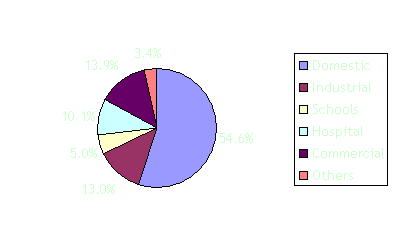
In the case of Lochgilphead, the biggest consumer
is obviously the domestic sector with nearly 55% of the energy requirements.
Then comes the industry sector with 13.0%. The hospital requires 10.1% of the
total energy consumed by Lochgilphead but is a particular case, as it requires
a safe continuous supply.
Demand Profile of the 30th of December
The following graph shows the demand
profile on the 30th of December.
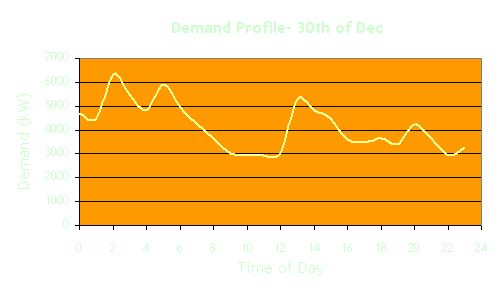
This graph emphasizes the effect of the Economy 7 policy implemented by Scottish Hydro-Electric and Southern-Electric, which we described in the introduction to Lochgilphead. The highest demand occurs early in the morning as expected. There is also a peculiar peak at around 13h00 that occurs every day of the year regardless of the season.
Peak Profile for the Year
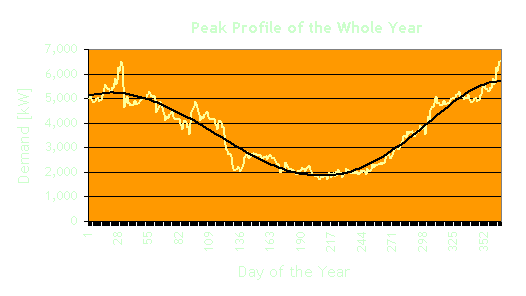
This graphs underlines the seasonal aspect of the energy demand at Lochgilphead. Indeed the peak energy demand during wintertime is more than three times the peak demand during summertime.
Current
Annual Demand
The following graph shows the energy
requirements of Lochgilphead and the split between thermal and electrical.
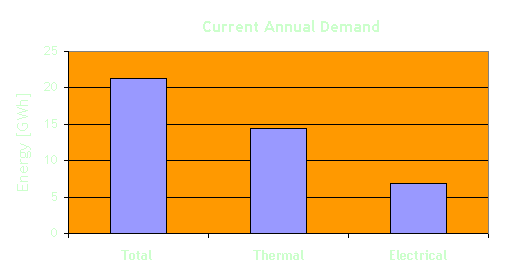
Using the 1991 census data, we were able to split the energy usage into
that used for hot water and space heating and that use for other energy
purposes. Hot water and space heating will be designated as thermal energy for
the rest of the project. All other energy requirements will be referred to as
electrical.
Peak
Demand
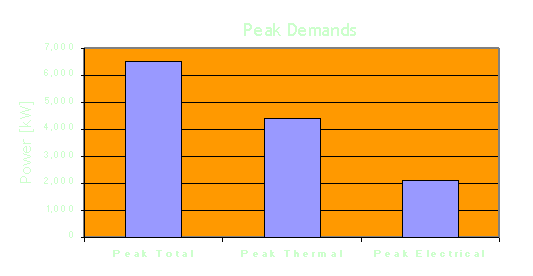
We split the total peak demand into thermal peak and electrical peak using the following factors:
- 13% of the energy consumption in Lochgilphead (1991 Census) was for industrial use. This was assumed to be electrical.
- To simplify the model it was assumed that the remaining 87% complied to U.K average domestic energy statistics i.e. the school, hospital and commercial sector had equivalent energy consumption to the average U.K household
- U.K average household statistics show that 60% of energy consumption is space heating and 18% hot water (Towards Sustainable Architecture: European Directives and Building Design; Brian Edwards; Oxford; 1996)