









 |
| Lab Tests | Conclusions |
As a first approach to the Power Quality Analysis related to the grid connection of
PV generation schemes, we decided to characterise a simple inverter: a zero cost inverter
used to connect AC appliances to car batteries.

Photo 1.Steven and a general view of the experiment devices
Inverter characterisation
Aim: The purpose of the lab test was to monitor and understand how the inverter works at different power levels and the distortion of the output power wave for each case.Material used
- Inverter: 200 Wp inverter with 13-15V DC input and 220V 50 Hz AC output.
- Car Battery: Power source imitating the output of a PV panel array generating DC.
- Variable power loads: Adding bulbs with different power requirements we simulated a variable load.
- Oscilloscope: To look at the form of current and voltage waves in the AC side,
capture them with a PC and analyse them.

Photo 2.Freezing inverter's output signal in the oscilloscope
- Voltmeter: To measure voltage and current in the DC side.
- Electrical Wave Spectral Analyser: Software called WAVESTAR to catch the frozen
wave and do its harmonic
decomposition calculating the current and voltage RMS values and the Total Harmonic Distortion.
It is also possible to calculate the value of each harmonic as a percentage of the fundamental.
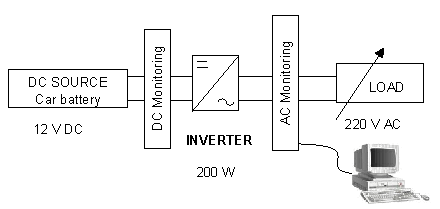
Fig. 1. Main scheme of the laboratory tests
Methodology
The steps we followed to carry out the experiments were:
- Planning: Before going to the labs we planned carefully the steps to follow deciding which should be the main measurements to get a successful output from the test.
- Setting up:
- Connect the car battery to the inverter.
- Plug the chosen load to the inverter.
- Measure the voltage¤t on the DC side
- Take the AC voltage¤t signals from the AC side in two channels of the oscilloscope.
- Capture frozen signals in the oscilloscope and analyse them to get the harmonic decomposition. The quality of the output signal from the inverter can be measured assessing the distortion of the current supplied.
- Result analysis:
- Transfer the output information data from the PC to a spreadsheet to analyse it.
- Extract conclusions, plotting graphs.
- Check results and compare our particular inverter performance with commercial PV inverters.
The output current&voltage signals of the inverter are completely different from the mains. There is a notable distortion in comparison with the quite perfect sine wave we can get in the socket. In the next two figures (Fig. 2. and Fig. 3.) it is possible to see the difference.

Fig. 2.Mains voltage signal

Fig. 3.Voltage and current output from the inverter with a 40 W load
As we increased the power demanded from the inverter, the voltage and therefore the current signal start to change. The zero voltage step becomes shorter until it disappears at high power levels. It is possible to see it comparing Fig 3. and Fig 4.

Fig. 4.Voltage and current output from the inverter with a 200 W load
Efficiency
Due to the internal consumption, the inverter works quite inefficiently
with low power ratings. Nevertheless, gives an average efficiency above 80% in load levels above 60%,
as shown in Fig 5.

Fig. 5.Inverter efficiency for different loads
Total Harmonic Distortion
The form of the voltage-current signal is dependent of the load plugged into the inverter.
Therefore, we get different THD-s for different power demands as shown in Fig 6.

Fig. 6.Current THD
As it is possible to see in the next graph, the predominant harmonics of an inverter are odd harmonics due to the square wave it generates. Even harmonics are usually less strong and sometimes only the first two odd harmonics (3rd and 5th) are taken into account. In this particular case the THD is very high (around 44%) for the rated power and a bit less but still high for a 15W (7.5%).
In most of the cases the power that has each harmonic decreases exponentially as we consider higher frequency harmonics. It is quite obvious in Fig 7. It is possible to find very good but very expensive inverters in the market, than could supply an almost perfect sine wave with a negligible THD.

Fig. 7.Current THD
However, we can say that the previous affirmation is very clear when the inverter is working at rated power. Fig 8. shows that at 15 W (7.5%) the energy transmitted in higher harmonics is also smaller but the percentages referred to the fundamental are quite random.

Fig. 8.Current THD
Conclusions
The knowledge acquired thanks to the laboratory test could be resumed in the next conclusions:- The output waveform of the inverter is very square in comparison with the mains.
- Our particular inverter has a square output signal with a very high THD (44%)
- The THD increases at high load levels.
- The efficiency of the inverter is around 80% at high load levels and much smaller at low levels.

|
Back To Top |
| Home | Overview | System Design | Grid Connection | Environment | Economics |
| Links | About Us |
© Copyright 1999 Bastarrika Kalantzis Zurutuza
Updated 12 April 1999