THERMAL DEMAND AND SUPPLY.
Thermal Demand
We used steady-state calculations to calculate annual thermal demand sums and provide a means of supply. We did not try to decrease the demand as the housing already implements some energy efficient technologies of decreasing (super insulation and double low-e glazing).
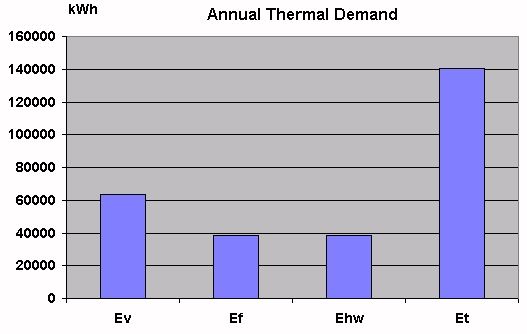
The degree-days method was used to calculate monthly losses. For the fabric losses Ef, we considered separate U values for the fabric elements. As far as the ventilation lossesEv are concerned, a value of N=0.8ACH (the air changes per hour) was used. For the hot water we considered a 50lt/person daily consumption, and estimated the number of residents in each of the 16 flats in the Sustainable development housing scheme. The results are shown below:
|
Heating Losses |
KWh |
|
Ventilation losses |
63000 |
|
Fabric Losses |
38500 |
|
Hot water Losses |
38500 |
|
Total losses |
140000 |
The results show clearly that a great amount of energy could be saved by using mechanical ventilation with heat exchange. The energy saved could theoretically be huge. The use of a ducted mechanical ventilation system would require redesign of the heating system which at present uses a water-to-water heat pump with radiators. We did not consider this case for various reasons.
Nevertheless, mechanical ventilation with heat exchange applies to our thermodynamic degradation approach. We wish to reject energy at only the lowest grade possible. Ventilation heat exchange allows us to do this by cooling the outgoing air. We are extracting a benefit from our room air as it degrades from room temperature in ambient temperature.
Thermal Supply
To utilize low grade energy for our thermal supply, we used a heat pump (that was implemented originally to utilize coal mines' water as a heat source).