Method of supply
- Amorphous silicon modules with an efficiency of 6%. The facade would require a huge area, of tilted roof. The area argument favors silicon monocrystalline or polycrystalline PV modules that have 2.5 times the efficiency of amorphous silicon modules. We did not consider roof-tiled Amorphous Silicon modules, because they cost twice as much as the other two. (1997 UK prices2 were for amorphous silicon modules £3.9/Wp, for monocrystalline or polycrystalline modules £4.04/Wp, while for roof-tiled Amorphous Silicon cost about £7.9/Wp).
- Typical silicon monocrystalline or polycrystalline PV facade of 24kWp power, covering the annual electricity demand of approximately 14.600kWh (we assume each of the 16 flats daily consumes only 2.5kWh of electricity). The facade will be south facing tilted at an angle of Glasgow’s latitude (or less, i.e. 35o to optimize its performance for winter radiation levels). The installation shall be a grid connected one.
For our calculations we assumed a medium efficiency of 17% for the modules, a pollution factor of Kpv=10% and wiring and inverter losses nbos=25% were considered. The area the 24kWp modules will use is about 165m2. (We chose a high efficiency due to the low annual radiation figures we had for Glasgow, resulting in Gannual=900kWh/m2, while a figure of 980 kWh/m2 appears as standard. Nevertheless latest BP modules have this efficiency and an even better overall performance in northern latitudes, due to laser grooving techniques. Finally, we icreased the area oversizing for the facade (assuming a cover ratio of 0.85 for BP585 Saturn modules, for a 85Wp delivered module).
The problems arising of using a PV facade to supply demand are the following:
- Management of demand. During sunshine hours, the PV facade shall be operating at a sufficient level. In the summertime the power produced shall be much greater than the demand, thus having to be supplied to the grid (used as storage). Monthly calculations show that from October until February supply shall be smaller than demand, as is shown in figure 1, below.
- Payback period. In UK up to now, domestic installations do not favor the use of PV, due to the great cost of PV modules, approx. 4.5£/Wp (=4£/Wp per module + installation costs2. PV installations shall not become financially attractive, until a maximum cost of 1.2£/Wp is reached (manufacturing plants now being built are supposed to decrease current price to that price level.)
However instead of a money payback period perhaps we could consider an energy payback for the PV Then PV facades become attractive. PV modules have a quick return of investment in energy terms.1 The energy payback period for polycrystaline and monocrystalline modules have, about three times as much as the Amorphous Silicon modules.
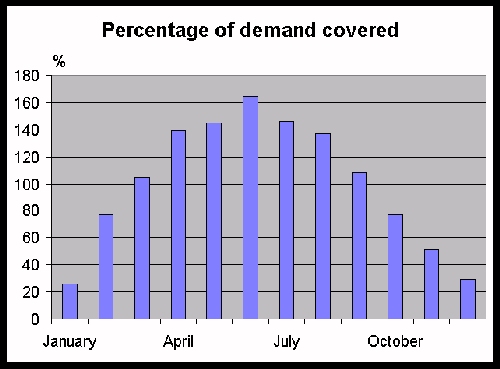
FIGURE 1:
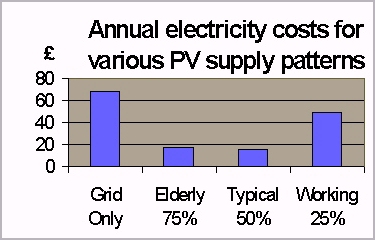
Utilities in U.K. buy individually produced PV electricity aprrox. 2.5p/kWh (though selling at 7.5p/kWh). Nevertheless, a management of demand scenario, assuming a 50% demand during sunshine hours (PV producing time), results in annual payjents of £16 for the tenants. Even a bad case scenario of 25% use, results in annual payments of £48 for each flat. In table 2 three scenarios are presented: a best case (75% in site use), a possible case (50% use) and a bad case (25% use) along with the money each flat would have to pay annually.
Even in the best case scenario, the annual gain from generated electricity, does not exceed £50. Considering, an annual bill fo only £63 if electricity was bought solely from the grid, the gain is very small to justify the investment. The good point seems to be the small differences between the good (elderly-75%) and the moderate (typical 50%) cases, which suggests a rather good supply of actual demand. We did not take into account though the increase of electricity consumption during winter time.
|
Demand covered |
0,75 |
Each flat annually |
15 |
||
|
Demand covered |
0,50 |
Each flat annually |
17 |
||
|
Demand covered |
0,25 |
Each flat annually |
48 |
||
The negligible CO2 emissions of PV during their life cycle, not only makes them environmentally frinedly, but also contributes to the 2010 target of reducing UK CO2 emissions, thus making an environmental statement. And if a percentage of the money subsidizing nuclear power, was redirected to subsidize a PV installation programme like the German "1000 roofs" programme, the PV market in UK could start to evolve.
References
1. Ecotopia
2. Proceedings of the 13th and 14th European Photovoltaic conference.
3. IEA Task 16, Building Integrated Photovoltaics.