A. Introduction
One interesting feature our building has is an atrium area located at the south-facing side. We wanted to investigate its benefits on the heating load demand of the flats adjusted to it. Our intention was to discover if the heating losses in an well-insulated house could be further
reduced using a cheap and high grade of energy : the solar heat.
From a thermal point of view, a building is a complex network of thermal resistances and capacitance's linking different regions and representing conductive, convective, advective, radiative and heat storage processes. On other words, studying the thermodynamic performance of a building isn't an easy task. To proceed to our research, we decided to use an appropriate software program named ESP-r, which has been developed by the University of Strathclyde.
B. About the modeling
The ESP-r program is a dynamic thermal simulation environment for the analysis of energy and mass flows and environmental control systems within the built environment. ESP-r ("r" stands for Research and EU Reference) allows researchers and designers to assess the manner in which actual weather patterns, occupant interactions, design parameter changes and control systems affect energy requirements and environmental states. (For further information click on http://www.strath.ac.uk/Departments/ESRU/)
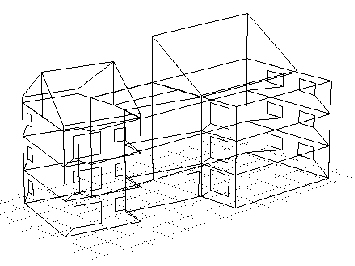
If fact, two virtual models with different construction were made: One as the building actually is going to be; on the other one the atrium has been replaced by a simple hall with stairwells. As you can see at the picture provide below both are accurate models of the actual building - by the exception of the non-atrium case.
C. The simulation process
Three different simulations were carried out:
On the first case, there wasn't the glazing area of the atrium. What's more, the flats were
natural ventilated using the ambient air.
On the second case, still there was no atrium but the flats were ventilated using the air captured in the stairwell's space.
On the third and final case, since the atrium was present, the sun was heating the air inside.
The flats were ventilated using the atrium's air. On other words, we simulated a solar pre-heated air ventilation system.
Our main target was to investigate the heating loads of the flats adjusted to the atrium. Some other aspects were also investigated such as the ventilation's loads, the indoor air's quality and comfort, shading effects, e.t.a. The picture provided below, was taken while we were investigating the atrium's inside temperatures in comparison to the outside's and one flat's
D. Results
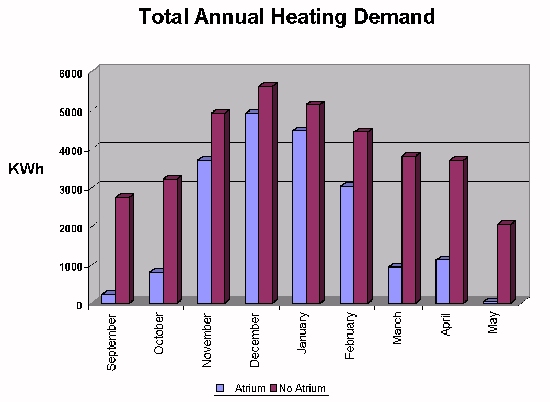
The heating installation for all cases worked under the conditions given below: Inside temperature of 20 C, full-time domestic occupancy. The total annual heating requirement for the first case was 35600kWh, for the second case was 26300kWh and for the third case 19220kWh. On our case study, we had also used the degree-days method to calculate the possible heating demand load for each flat and for the flats next to atrium the figures were very close to those of the first case. The atrium is responsible for a 40% and 25% reduction of heating demand. There three reasons for those reductions: First, the fabric losses from the flats to the atrium's space were reduced. Second, there is practical no need for heating during the month of May when there is an atrium-case. Actually there are some flats that don't need heating even on September and on April. But the most important reason is the general monthly reduction per flat: During the winter season is in general about 10-14%. But during the eastern or autumn seasons it varies for each flat according to size and the environmental conditions it is facing. A visual comparison between the worst and the best case is shown at the table below.
E. Conclusions
In our case the atrium was beneficial on. Using the power of the sun which doesn't cost a penny and having increased the stairwell area less than 8 square meters per floor to add the glazing surfaces and create an atrium , we have significantly reduced the heating load demand.
If we compare the first and the second case where we have 27% difference due to the temperature of the source of the air needed for ventilation, we can verify the importance of a good ventilation in a well insulated house - like ours- to the energy demand.