|
Transmission strategies |

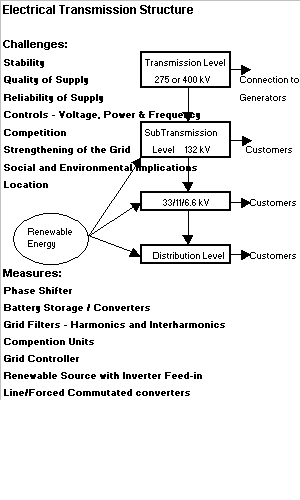
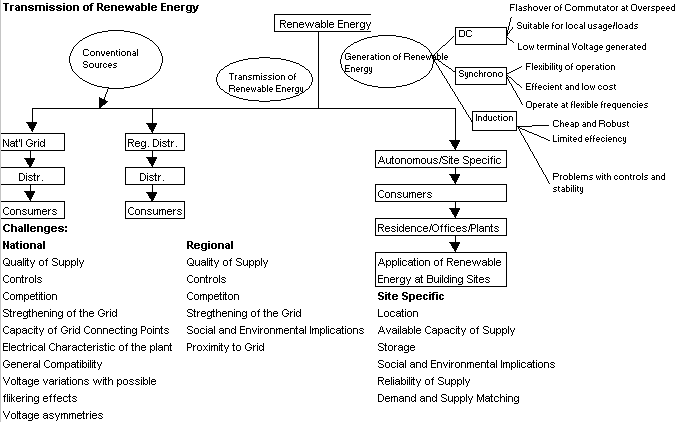
Transmission of energy in the form of electricity and gas has been around for a long time and it usually involves 3 basic levels of transmission: National, Regional and Site Specific. However, the transmission of electricity from renewable sources is relatively new and especially when it involves connecting renewable sources to an existing grid, several factors have to be taken into account. These factors are challenges which need to be addressed before transmission and connections could be established.
Whether the transmission is at the National, Regional or Site specific level, the challenges faced could either be repetitive or unique to one particular level.
Starting from the point of conversion (Renewable Energy to Electricity) there are several options of generators to choose from, each having its own advantages/disadvantages. In wind turbine systems for example, Synchronous generators offer flexible operating frequencies, and they are efficient and cheap. DC generators are suitable for local applications and have low terminal voltages but have problems of flashover of commutator at overspeeds. Induction generators, on the other hand, are cheap and robust, but they have low efficiencies and have problems with stability and controls.
|
Looking at transmission at the site specific level, some of the challenges which are quite common are Storage, Controls, General Compatibility, Voltage Variations with possible Flickering Effects, Voltage Asymmetries, Harmonics, Interharmonics and Disturbance Emissions. Measures taken to compensate for these power electronic problems involve installing Phase shifters, Grid Filters, Compensation Units, Grid Controller and Line/Forced Commutated Converters. Storage could be provided through the use of batteries or even flywheel technology. Equally important, in the transmission of renewable energy, are other factors not directly related to power electronics like Supply and Demand Matching and Social and Environmental Implications. |