Introduction
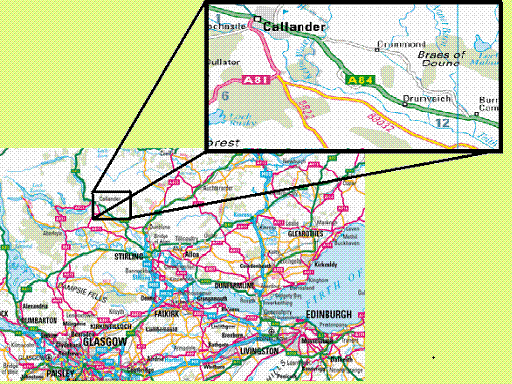
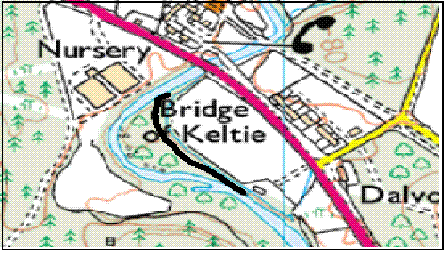
Site 2, can be found just at the Keltie Bridge. The Building named Nursery is actually a mushroom farm and is the proposed load.
The black line on the figure below denotes the mill way for the now disused mill. The mill’s location can be seen below it is represented by the small rectangle just to the east of the tip of the black line.
The mill was built in the late of the 1800s and continued until the 1940s.
Although interestingly, it was converted from a water wheel system to a diesel generator, at the turn of the century.
Keltie Bridge - Mission
“To produce a complete hydro feasibility study of the Keltie Bridge site in order to determine the options for installing a small scale hydro system to help the Baillie-Hamilton’s achieve their goals of self sustainability”.
The surveying measurements were taken as described in case study 1. Below are our findings.

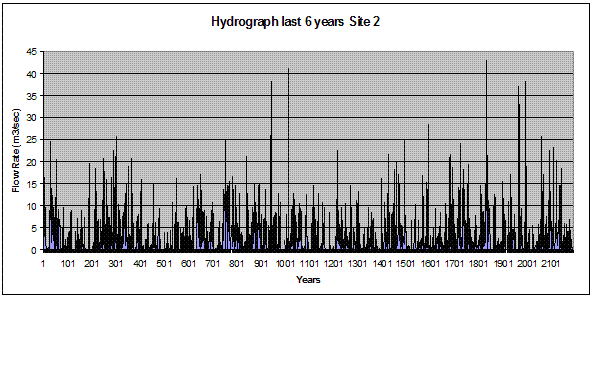
Using the same method like in the case 1 we firstly calculated the direct flow (please see excel sheet below) using the appropriate rainfall data, which provide us the meteorological office as we said and before. Then we made the hydrograph for the last 6 years for the specific site as you can see below.
Working out the demand of the mushroom farm was a little more straightforward than the other two case studies. A short time ago the owners upgraded the heating system to an automatic heat pump. It operates by having two heat pump systems working in conjunction with each other. One acts as a heater while the other acts as a cooler. Together they keep a constant temperature in the nursery. The system is working 24 hours a day, 7 days a week. This leads to constant use of energy and is rated at 70 kW. This is the figure that we hope to achieve with the hydro scheme and will also be the benchmark for costing compared to what will actually be achieved.
Since the turbine selected for this site is similar to the one in Site 1 please refer to that page for details
Costing of Keltie Bridge Site (Case study 2)
We have calculated cost and pay back period for this case study in the similar
manner as for the case study 1.
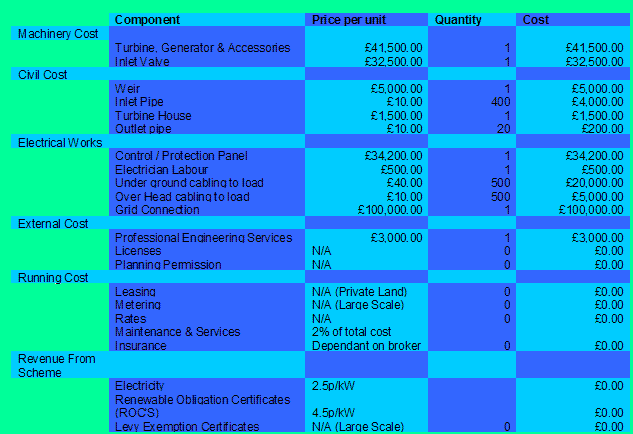
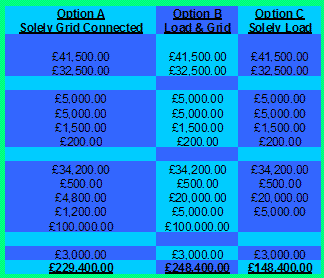
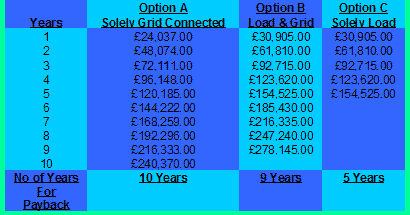
We have taken into account the cost of all the major components and then calculated the payback period for the three different options.
The details of these costs can be viewed in the spread sheet
that contains the details costing of these sites.
As this site has similar specification as was in the case study1. We will use the
Toshiba Hydro ekids M for this case as well because this can work efficiently for this situation.
This site has head of 5.2 meters and we are taking rated
flow for the turbine as 1.4 m3 /sec and 0.1 cut-off flow.
The total potential of power for site is about 50kwh under this condition. We need some sort of heating
mechanism to keep the control panel/systems warm for the purpose of avoiding any
kind of short circuiting because of moisture. So some power will be used for these electric heaters.
Here again we are considering that this turbine will work at rated power at least 80%
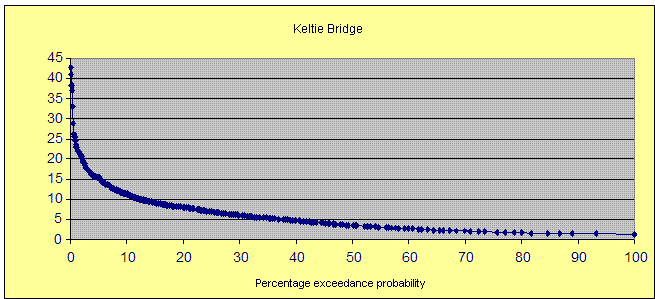
of the year and half of the rated for 20% of the year. It is estimated from the FDC (Flow duration curve of this site). The flow duration curve for
case study 1 and 2 are very similar to each other as they lie on the same river just half
kilometer apart from each other.
Options for power connection: