A South Facing Ducted Wind Turbine was positioned on the roof of the James Weir Building and the generator was linked to a computer using a programme called labview. The Purpose of this was to investigate the turbines response to changes in wind speed and direction and to establish suitable uses for the generated electricity.
Small wind turbines, coupled to permanent magnet generators were originally designed for battery charging, though grid connection may be a more useful application.
The introduction of the concept of ‘micro-grids’, where a variety of micro-generation plant are connected in a centrally controlled network, makes the idea of grid connection more relevant.
Wind direction and speed were recorded simultaneously with generator voltage at a high sampling frequency.
An example of a dataset can be seen below:
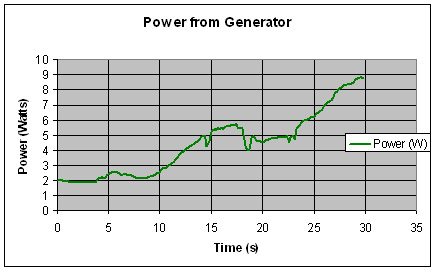
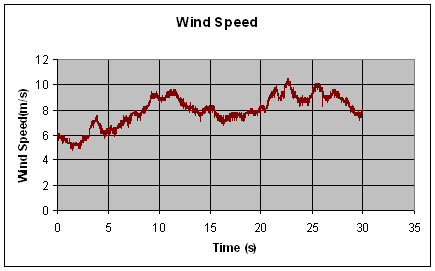
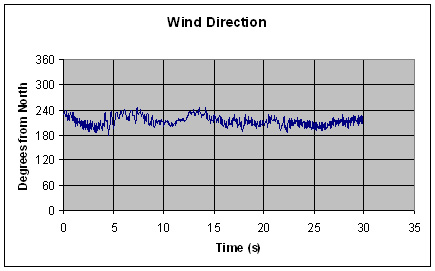
These graphs are an example of 30 seconds of generator output over a 22.5 ohm load resistor.
As expected the inertia of the turbine filters out some of the fluctuations in wind speed.
However, it was noted that when the wind is not blowing directly in to the duct the power output is disappointing. In this example the wind fluctuates between 20-30 degrees from due south.
If DWTs are positioned along the edges of a building with 90 degrees of separation, as proposed, certain wind directions would lead to a high level of fluctulence.
Grid Connection
Grid Connection of a DWT would use an AC/DC/AC topology as shown below:
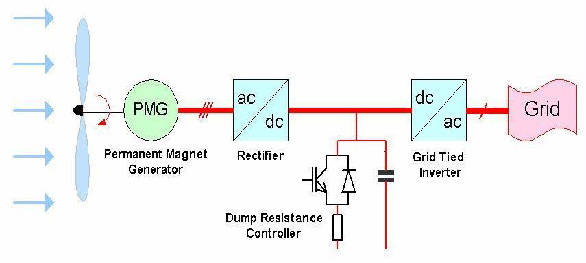
The AC output from the Permanent Magnet generator is first rectified to DC, before being converted back to an grid compatible, AC voltage.
The grid tied inverter is a complicated piece of apparatus and will have a limited range of DC inputs that can be converted to Grid compatible AC at acceptable quality.
At low voltages most inverters will suffer from harmonic distortion and DC injection and below a certain threshold the power will have to be dumped.
This has implications when a highly fluctuating generator output is connected, presenting the grid with a high level of intermittence.
With this in mind, grid connection of DWTs may not be the most useful way of using the power when low numbers of units are concerned.
Connecting large numbers of rectified generators to an inverter would boost the inverter input.
Using Batteries as a storage device would solve the problem of intermittence and make use of the power from low voltages.