Introduction
We have been offered the opportunity of applying our methodology to a construction site near to Prestwick airport. The construction site will become the new NATS control building and covers approximately 550 square metres, with a range of land use, from office space and facilities for the workforce in the form of a construction village, through to the new site of the building and associated supply and storage areas for construction materials. We will be applying our methodology to the entire site taking each area into account.
The construction village comprised of 24 modular cabins linked together over two storeys. The modular cabins in the village were of different generations, with one type conforming to current building standards and the other being an older model with a lower specification of insulation.
Aims and objectives
By applying our methodology to the site we hope that we will achieve the following outcomes from this casestudy;
- Once we have applied the methodology to the different areas of land use within the site we hope to generate feedback and improvements to our methodology.
- As part of the casestudy we will be conducting a review of the energy needs of the different areas of the site. This review will focus on energy efficiency information that is relevant to the contractor.
- We hope to show how generation from renewable resources can help supplement the site's power supply.
Data collection
We travelled to the Prestwick site and met representatives from the contractor and discussed the project. We were given a great deal of specific information about the site which would allow us to calculate the loads that were present.
For this case study we gathered information about the numbers of workers, the equipment and activities in the cabins, the equipment on site, the proposed schedule of activities and the necessary resources for different phases of building construction.
Energy conservation
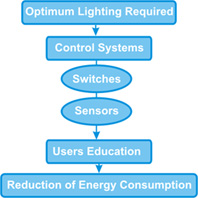
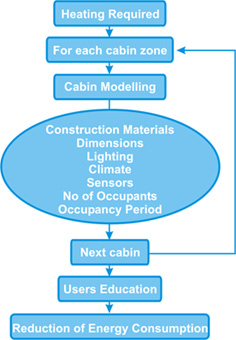
The focus of our energy efficiency study will be on the construction village where we will try to reduce energy consumption associated with the workers behaviour and their use of electrical appliances. We reviewed the largest demands of lighting, heating and hot water in the construction village. However, in this all electric environment the dominant loads were lighting and heating. It would be in these areas where we will be able to achieve the greatest reduction in demand.
The heating was controlled by a thermostat or a variable heat output control on the convection heaters. However the thermostat and the heat output controls were often set to the maximum and left switched on even if the office was unoccupied.
All of the lighting was of the fluorescent tube type with two bulbs per luminaire and no reflectors. There were set out in a standard pattern and did not account for the actual use of the space that they were illuminating in the cabin. As a result the lighting was often inappropriate for the space and could be substantially reduced.
The lighting tended to stay on all day despite there often being enough natural light available.
Due to the linking together of the different cabin modules, the lighting that was available was often poorly controlled.
The other loads that made up the rest of the cabins' demand were from general office equipment such as computers, fax machines and a refrigerator in the small canteen on the upper floor.
Define time period
We defined the time period as one day because the data lent itself to daily calculations. If larger timescales are required the daily power demand will be scaled up.
Grid and supply options
The generator is rated for loads up to 250 kVA. Generators should be run at full load whenever possible to maximise their efficiency, because at part load, there will be a drop off in their efficiency.
There are a couple of supply options that were investigated to supplement the electricity from the generator being used in the cabins and on site. These were generation from wind and solar generation in the form of photovoltaic (pv) panels.
Solar
There is potential for pv panels as the site is open without any shadows being cast by the surrounding buildings. However there may be some structural issues with the mounting of the panels on the roofs of the upper storey of the cabins. There must be provision for regular access to the units for maintenance in order to keep the outer surface of the cells free from dust.
We modelled the generating capacity of a pv installation using Merit and found that the power from such an installation would be quite small. With this low output, the price per kWh would be far higher than that from the diesel generators, so the solar installation was discarded.
Wind
Due to the site's location and the proximity of the current NATS building, there are very strict guidelines about the type of equipment that can be placed nearby. Between these stringent regulations and the heath and safety implications of having a wind turbine active on the site, we decided not to pursue this method of supply.
Compare supply and demand profiles
On the site the supply was always equal to the demand with the generator tracking and supplying the load up to its nameplate rating of 250 kVA.
Apply DSM techniques
In this case study we quickly identified that there were limited opportunities to shift loads because the employees had a high priority of use of their equipment. As a result the main DSM technique used in this case study will be the efficient use of energy on site.
We have stopped the methodology here because the two subsequent steps are not applicable to this particular case study. |