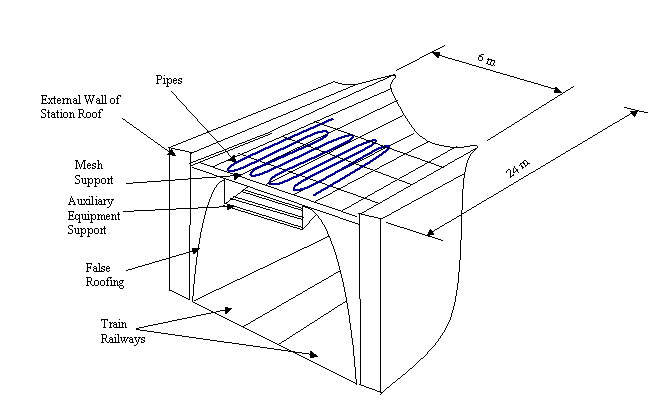

The warm air flowing around the underground station due to train movement will move up and fill
all of the spaces. By laying pipes on top of the station's false ceiling, low grade energy could be
extracted.
A manual temperature measurement was taken and it showed that the ambient temperature in the underground
station was between 13 and 14 oC.
The material of the false roofing was unknown at the time the study was completed therefore
it was assumed to be either cladded metal or plastic based material.
To support the pipes that are being laid on top of the ceiling, a tubular mesh would need to be
constructed. Alternatively the pipe could be held via a plate, that is, flexibly attached to
the pipes
and rigidly bolted to the side walls. The final choice would be made after an agreement had been reached between
the contractor and Strathclyde Passenger
Transport (SPT).
To calculate the amount of extractable heat several factors were examined: pipe length available,
flow
of working fluid and ambient temperature
around the pipe. All the thermal resistances must be taken into account in determining
the temperature drop.
For the amount of heat extractable using 121 m2 area of pipe we could get less than 2
kW energy.
This option has a significant disadvantage due to the turbulent air and the fact that the
station is not an enclosed space. Therefore, warm and cold air can move freely and
the low grade energy lost due to the lack of insulation.
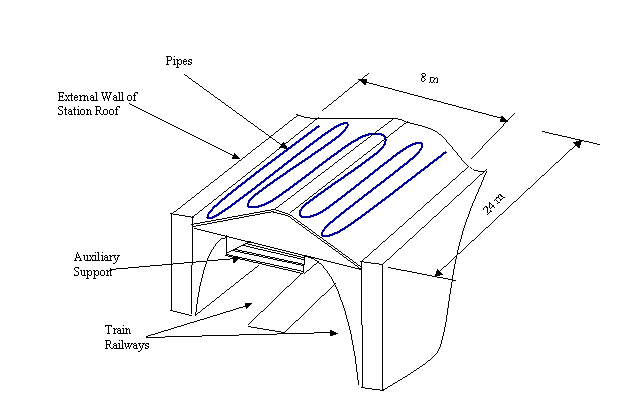
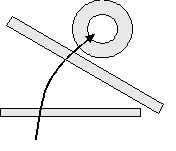 This option is similar to the first, however the warm air has to overcome
more thermal resistance particularly from the roof which is made of corrugated cladded aluminium.
The area available for heat extraction is 96 m2. Above the roof there will be a raised decking
built to conceal the roof from any unauthorised access.
This option is similar to the first, however the warm air has to overcome
more thermal resistance particularly from the roof which is made of corrugated cladded aluminium.
The area available for heat extraction is 96 m2. Above the roof there will be a raised decking
built to conceal the roof from any unauthorised access.
In this method, the pipes would be suspended on top of the roof. Some structural
means of holding these pipes must be designed, as mentioned in the first option.
From calculation, the energy extractable is less than 1 kW. This is the least amount of energy extractable from all the options.


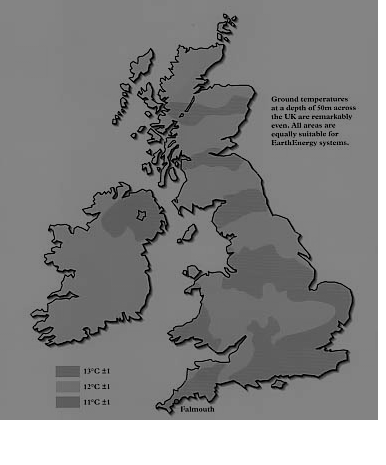
Below is a map of average ground temperatures across the UK.
The third option is known
as Vertical type closed loop ground source heat extraction scheme. The area available around
the Underground station roof made possible 3 boreholes. 1 borehole could
extract around 12 to 21 kW of heat from the earth depending on the depth. From the map below it can be seen that
in Glasgow at a depth of 50 m,
the temperature is approx. 13 oC.
Vertical trenches must be built as shown in the picture (in heavy black lines), with the pipe surrounded by grouting material
to help increase the efficiency. With the area available, only a single row
of trenches is suitable. Typically a borehole must be made
1.5 m away from the nearest wall, and the distance from 1 borehole to another should be 5 m.
The figures quoted take into account the borehole diametrical size plus the neccessary grout
space around the boreholes.
Borehole drilling is costly taking up £500 to £2000 per borehole. The major advantage of
borehole type energy extraction, is that it makes the most of the area available.
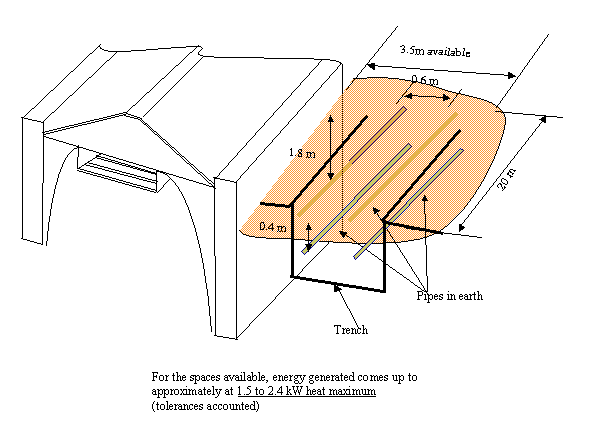
Laying the pipe horizontally may also be considered for energy extraction. A trench would be dug to accommodate the pipes as shown below and this scheme is the optimum layout possible for the Horizontal type. The trench would need to be 1.8 m deep with the pipes laid 1.8 m from ground zero. Allow 0.5 m from the side wall and 0.6 m between pipes horizontally. For the combination proposed an extra 0.4 m in parallel-vertical depth would be necessary to add a parallel pipe. The energy extracted is in the region of 35 to 55 m per kW. This is approximately 1.5 to 2.4 kW extractable heat.
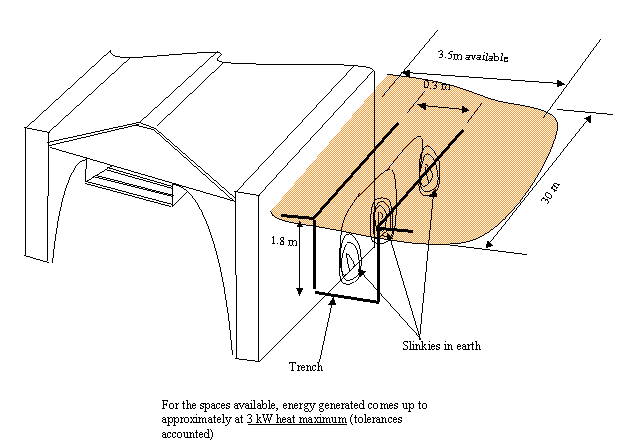
To increase the area available for heat extraction using the horizontal layout, slinkies could be used in place of a normal pipe. Slinkies are pipes which are rolled as shown and connected to one another. This design would maximise the surface available for heat extraction. A similar trench would be dug to accommodate the pipes as shown above. The trench must be dug 1.8 m deep and the pipe laid 1.8 m from ground zero, allowing for a clearance of 0.5 m from the side. With slinkies, the trenches must be postitioned 5 m apart therefore for this site only a single trench is possible. The potential energy extracted is 30m per kW, approximately 3 kW extractable heat.
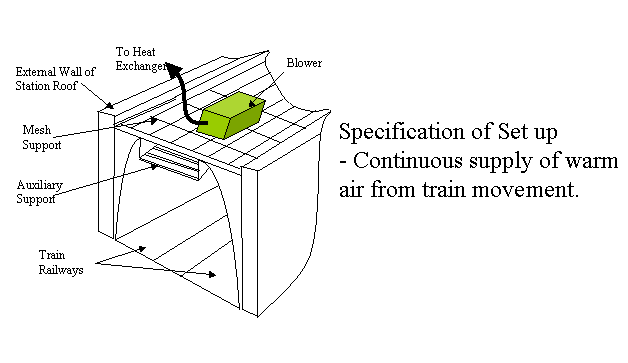
The last option looked at for heat extraction is to directly move the warm air from the underground
station via a blower pump fitted on top of the station’s ceiling. The warm air would then be sent to
the heat exchanger part of the Heat pump system located within the building. Using this method,
the warm air transfer duct must be properly insulated to ensure no significant heat loss before
reaching the heat exchanger. The amount of energy
transferable depends upon the sizing of the heat pump and the optimum efficiency balance that
the extractable heat can provide.
Relevant Material Information
Option 1 & 2 – The pipes would be made of copper, size around 32 mm OD
Option 3, 4, 5 – Pipes are plastic
Relevant Material costing refer to: http://www.kensaengineering.com
The table shows a comparison of the energy extracted using the 6 proposals. As shown, the
pipe buried vertical option
can provide the highest low grade energy extractable
within the available area, however this option has the highest cost
weighting which is not so good. As mentioned earlier,
this option could have a low cost weighting if
good planning were carried out during the construction phase.
The last
proposal, the air source, appears to be a good
way of implementing a heat pump, however the warm air
supply may not be constant
as the underground only
operates for approx. 16 hours each day.
To conclude, from the heat extraction
study, we found that 2 proposals were suitable; the vertical
borehole and air source. The air source option is particular to this site due to the presence
of the underground system whereas the vertical borehole option could easily be transferred to a wide
selection of sites.
