
Navigation
- Environmental Benefits
- Carbon Dioxide Emmissions
- Growth/Maturity Factors
Environmental Benefits
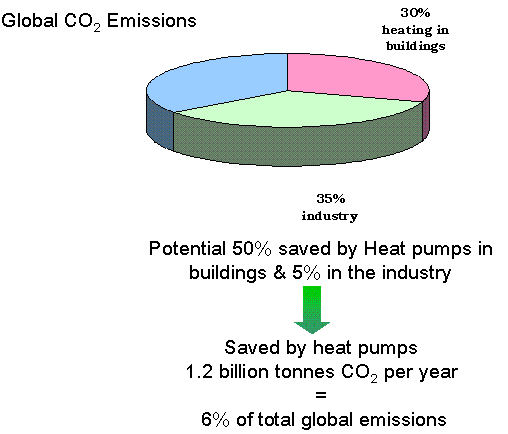 Of the global CO2 emissions that amounted to 22 billion tonnes in 1997,
the heating of building caused 30%. The potential CO2 emission reduction with heat
pumps can be calculated as: 6.6 billion tonnes CO2 come from heating buildings,
(which is 30% of total emissions). 1 billion tonnes can be saved by residential
and commercial heat pumps, assuming that they can provide 30% of the heating for
these buildings, with an emission reduction of 50%. A minimum of 0.2 billion tonnes
can be saved by industrial heat pumps. The total CO2 reduction potential of 1.2
billion tonnes is about 6% of global emissions. This is one of the largest
that any one technology can offer, and this technology is already available in
the marketplace. With higher efficiencies in power plants as well as for the
heat pump itself, the future global emissions saving potential may be as much as 16%.
Of the global CO2 emissions that amounted to 22 billion tonnes in 1997,
the heating of building caused 30%. The potential CO2 emission reduction with heat
pumps can be calculated as: 6.6 billion tonnes CO2 come from heating buildings,
(which is 30% of total emissions). 1 billion tonnes can be saved by residential
and commercial heat pumps, assuming that they can provide 30% of the heating for
these buildings, with an emission reduction of 50%. A minimum of 0.2 billion tonnes
can be saved by industrial heat pumps. The total CO2 reduction potential of 1.2
billion tonnes is about 6% of global emissions. This is one of the largest
that any one technology can offer, and this technology is already available in
the marketplace. With higher efficiencies in power plants as well as for the
heat pump itself, the future global emissions saving potential may be as much as 16%.

The ground source HP is responsible for lower CO2 emissions compared
to alternative heating systems. For example, compared with a gas condensing
boiler, the HP system resulted in 30% lower CO2 emissions. When compared with a new
oil fired boiler system or an all-electric system, a reduction of over 55% and 65% emissions of CO2 respectively could be achieved. In our case we assumed the heat
pump to be electrically driven, lower emissions could, however, be achieved by using CHP or any
other renewable energy source.
Table below compares CO2 emissions comapred with other alternatives
| System |
Annual CO2 emissions (kg CO2) |
% Reduction in CO2 emission by using Heat Pump |
| Heat Pump |
1211 |
- |
| All Electric |
3634 |
65 |
| Regular Oil fired boiler |
2700 |
55 |
| Gas fired condensing boiler |
1803 |
30 |
1. CO2 emission is calculated as : Oil -0.27 kg/kwh, Gas-0.194 kg/kwh,
Electricity-0.46 kg/kwh
2. Overall performance factor for heat pump taken as
3- from a heat pump monitoring report of UK
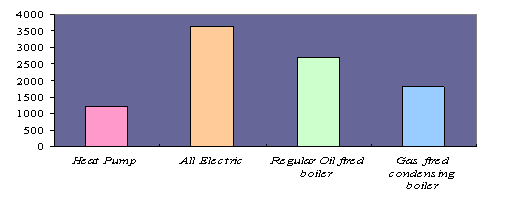
CO2 emissions comapred with other alternatives
Installation of Heat Pump systems in domestic/ office complexes
is a step towards meeting the national CO2 targets of reducing CO2 emissions by 20%
of 1990 levels by 2010. Heat pump technology has been acknowledged as one of the
major contributors in the race to reduce energy consumption. So HP users can save money
under the newly introduced Climate Change Levy by reducing overall energy use.
In some regions of the world, heat pumps already play an important
role in energy systems. But if this technology is to achieve more widespread
use, a decisive effort is needed to stimulate the heat pump markets and to further
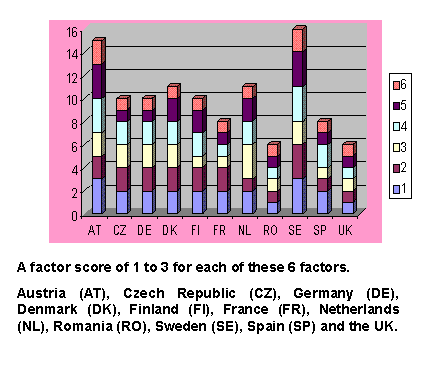
optimise the technology. By analysing specific growth/maturity factors we can
evaluate the heat pump market and determine whether it is static or dynamic. The
following factors are considered:
1. Availability of heat pump technology refers to the presence of
domestic or foreign heat pump manufacturers, agents or sales representatives who
offer heat pump systems through organised and trained resellers.
2. Economic incentives consider whether it is viable or even profitable
to install heat pumps compared to other heating alternatives, whether energy
prices are advantageous for heat pumps or not. To be competitive the heat pump
installation needs to have a payback period for the initial investment of no
more than 5-7 years compared to alternative heating systems.
3. Political decisions mean legislation etc. that promote heat pumps
compared to other heating systems. This can be standards or regulations
controlling the maximum amount of CO2 emissions and the maximum allowable
capacity (kW) of energy (kWh) for heating, or standards for sizing the heating
system to cover the heat loss of the dwelling and transitions to low temperature
heating systems.
4. Trained installers and resellers are essential for a functioning
market and continued market growth.
5. Awareness amongst end-users creates an autonomous, self-developing and
ongoing market where there is a "market pull" from end users demanding a better
heating alternative.
6. General acceptance among decision-makers, engineers, architects,
builders, housing associations, and electricity supply companies. These people
are the ones designing the buildings, consulting the house builders and owners
and informing the public. To obtain and retain general acceptance it is also
very important that the heat pumps offered on the market are tested and
reliable.
A sustained demand for the technology will encourage market players to
manufacture and market the product with increased confidence. A recent report
from The European Heat Pump association shows Sweden and Austria are best prepared
for widespread market penetration owing to a long tradition of heat pump
technology and continuous information/advertisement campaigns devoted to heat
pumps. Long-term use of the technology has also provided feedback on benefits
and time scales.
Growth/Maturity Factors of Heat Pump Market In various Europen Countries
Countries like Finland, the Netherlands and Czech Republic have worked
conscientiously to promote the product and are now experiencing powerful growth
and strong market development. Comparatively, the UK, has an underdeveloped
market. To achieve a sustainable market penetration for heat pump technology,
the six factors mentioned above must be promoted at various stages by the relevant
institutions.