Contents

Financial Analysis
Financial
Assumptions
The major assumptions made in
developing the financial analysis of the project are given below:
·
The financing
spreadsheet was obtained from the DTI at http://www.dti.gov.uk/renewable/pdf/Financing_Guide.pdf.
·
Corporation tax at 33%
·
Base lending rate at
6.5% for duration of the project plus 2% lending fees
·
Inflation at 2.5% for
the duration of the project
·
CHP costed at £1,400 per
kW installed. This information has been
developed from the CHP Club website at http://www.carbontrust.co.uk/energy/startsaving/tech_chp_CHP_club.htm. Useful information is also provided in DETR
Good Practice Guide 234 – Guide to Community Heating and CHP” which can be
ordered at www.bre.co.uk/brescu/.
·
Willow costings are
based on figures from the Scottish Agricultural College at www.sac.ac.uk/management/External/diversification/Energy/shortrotationcoppice.htm
·
Energy data pertaining
to CHP fuel is available at www.ecn.nl/phyllis/
·
Hydro costings are based
on figures at the www.smallhydro.com/more.html.
·
Wind costings were based
on information on the turbine manufacturer website at http://www.nordex.dk/. Additional information was also gleaned from
the National Wind Power site at http://www.natwindpower.co.uk/
and the Danish Wind Association website at www.windpower.dk.
·
District heating scheme
is costed on figures received from Shetland Heat & Power Company and is
costed for 7km of feed line.
·
The cost of improvement
to building fabric is not included in this project as it is assumed that this
would come from alternative funding arrangement
·
Depreciation of plant is
straight line over the life of the plant
·
This is assumed to be 25
years
·
The loan repayment
period is 14 years which was suggested in the www.DTI.gov.uk website
·
Electricity which is surplus
to the needs of the village can be sold under NFFO contract to the grid
·
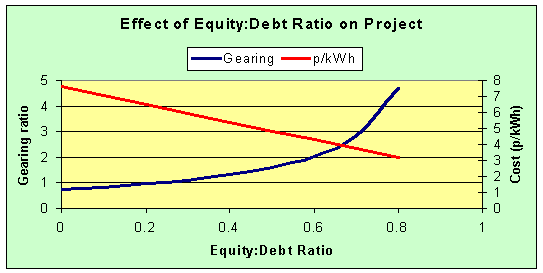
The ratio of debt:equity
is manipulated to achieve a gearing ratio of 1.3 (or just above)
·
Energy sales to the
village are priced at current average UK price and factored each year for
inflation rise.
·
All technologies have
factored in the cost of connection so it does not appear as a single item on
the sheet.
Summary of Major Findings
|
Property |
Result |
|
Total
Project Cost |
£14.373m |
|
Total
Borrowing |
£8.624m |
|
Total Equity |
£5.749m |
|
Cost of
Energy |
5.52 p/kWh |
|
Cost per kW |
£2245 |
|
Payback
Period |
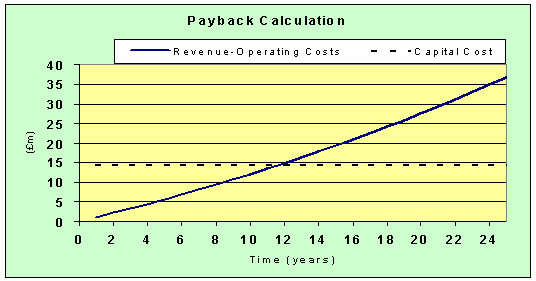
11.9 years |
Financial
Statement
- The payback period for the project is calculated
to be 11.9 years. This is
competitive compared to other renewable energy generation techniques.
- The project is extremely capital intensive. A level of 40% equity only produces a
coverage ratio of 1.26 – a figure that is likely to scare and indeed
frighten off major lenders. Projects that carry this level of equity carry
a high degree of risk.
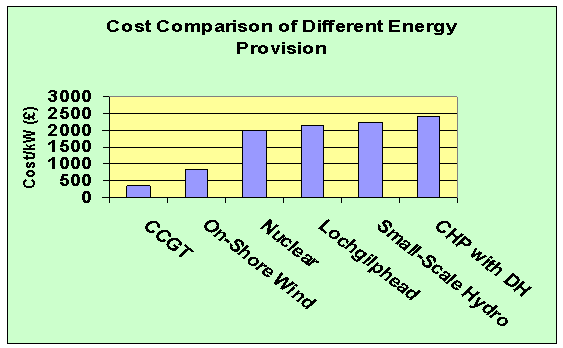
- A further measure of the high cost of the project
is the £/kW. Comparison with other
generation technologies shows the Lochgilphead scheme to be competitive
only with nuclear energy. However,
as this is being touted as the ‘new renewable energy’ this maybe no bad
thing.
- The CHP fuelled district heating scheme is the
major contributor to the project costs.
Start up costs for these schemes are extremely high and it is
difficult to proliferate in the UK without significant institutional
assistance.
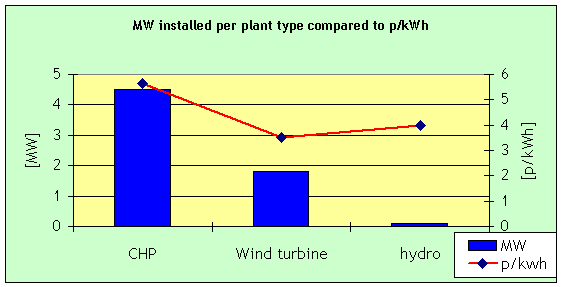
- The high cost of the CHP/District heating scheme
is reflected in the high p/kWh figure arrived at for this technology.
- The cost of electricity at this level is
5.52p/kWh, which is highly un-competitive when compared to other
generation techniques.
- The benefit of economy of scale is
exhibited by the cost of production estimated from the wind turbines.
Current NFFO contracts for wind energy are believed to be under 1p/kWh
(Ref Professor J. Clarke).
Possible Financing Routes for
Renewable Energy Schemes
As with the project described
in the case study, most renewable energy schemes are highly capital intensive
and require the developer to raise large amounts of finance in advance to the
start of operations. There are
generally 4 possible routes available for financing a project:
·
Use of bank loans
secured against other parts of the developer’s business or major assets.
·
Co-development of the
project with a financially strong joint venture partner
·
Limited recourse project
financing whereby bank loans are secured largely against future cash flows
·
Use of internal company
or personal reserves or obtaining funds from friends and business associates.
The two most likely options
are on balance sheet finance or limited recourse. Both typically use bank loans to provide the majority of the
capital but it is the lenders security arrangements that differ significantly
between the two routes.
Factors which affect the financing
decision
Do the developer/sponsors
have the financial wherewithal to provide the full financing requirement from
within their own resources, or do they wish to use then for the project?
Is the magnitude of the
potential financial obligations such that, if the project was a failure, there
would be serious damage to the financial health of the developer?
Are there specific project
risks with which the developer is not comfortable and desires to see laid off
in a structured manner to third parties?
Are there a number of
developers/companies with different financing requirements involved in the
project?
Is the project in a non-core
business segment for the developer?
Is the size of the project
too small to attract the interest of project finance lenders, who are unlikely
to consider a transaction where the debt component is less than £10 million?
Suggested finance route for
Lochgilphead case study
There are two possible routes
available for costing of the Lochgilphead project.
Option
1: Limited Recourse Project Financing
The project costs are split
between 2 or 3 sources. These would be
lenders, equity providers and possibly subordinated debt. The latter refers to the possibility that
equipment manufacturers would effectively accept on-balance sheet finance
arrangements for the purchase of their equipment.
For this to be successful,
firm contracts would have to be in place with all major project participants:
Fuel suppliers, equipment
suppliers, construction contractor, project operator and consumers.
The chart below indicates the
likely structure that would be adopted to facilitate the project given this
financing method.
However, the Lochgilphead
project is extremely highly geared and would require significant equity to be
available for the project to be viable.
Equity levels of 40% would be
required to see the coverage ratio in the 1.35 to 1.6 band in favour with major
lenders. This would make the project
high risk. Either that or the revenue
generated would have to be increased to increase cash flow levels.
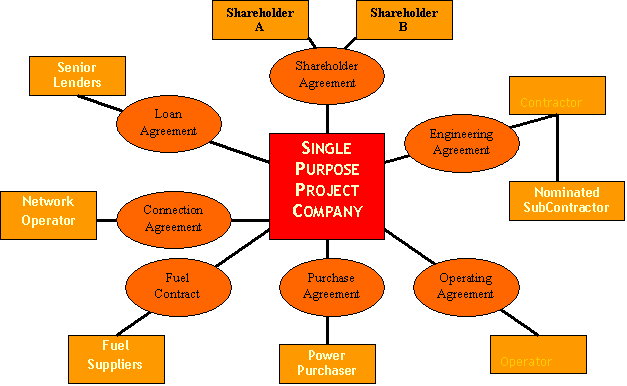
Figure 1: Suggested Structure of a Limited Recourse Funding Option
Option 2:
Co-Development
An alternative is that a
co-developer could be found to whom an interest (in whole or part) in the
project would be sold. Such companies
may be the existing PES or waste disposal company. With this approach, the developer would be responsible for the
initial phase of the project i.e. detailed feasibility study, after which
control would transfer to the co-developer.
They would then be responsible for the choice of route.
Most
Likely Route
Limited recourse funding
takes skill, energy and time. If this
skill is contained in the project team then it is possible that this route can
be taken.
However, it is more likely
that co-development will be the most efficient route. It may see some of the social initiatives of the project being
diluted by the need to meet big business payback requirements. Providing some interest can be maintained in
the project by the initial group some of these benefits can still be accrued.
Grants and Subsidies
The European Union has placed a great emphasis on the deployment of renewable energy in future energy requirements in Europe. This is largely to meet Kyoto requirements but also to address local regeneration and fuel poverty issues. As a result there are a number of grants and subsidy available to developments in this area. A brief summary of these is given below. Further information is available from the Europe website:
Subsidies are also available
for the deployment of renewable technologies.
The amounts available for this are project specific but up to 30% of
capital costs of a project of this nature can be covered under the ALTENER 100
Communities program. Further details
can be obtained at http://europa.eu.int/en/comm/dg17/altcalbr.pdf.
A focus on biomass grants and
subsidies is summarised below:
Focus on Biomass
In Europe a large number of financial
regulations is available to stimulate bio energy and other renewable energy
initiatives.
Examples are subsidies,
advantageous tax-rates and low-interest loans. Novem and Pi!MC have produced an
overview of all of these resources: "The European financial guide for
renewable energy, with a special focus on biomass". This guide was made on
behalf of the European Commission, Directorate General for Energy, DG XVII, and
financed within the framework of the European Commission Altener programme.
Objectives
The aim of this guide is to
help finance European bio energy projects and other renewable energy projects.
Renewable energy plays a key role in sustainable development targets of the
European Union and its member countries. Bio energy is one of the most
potential renewables. As renewable energy is often more expensive than
traditional energy, several financial incentives are brought into action in
order to change this. The European Financial Resources Guide provides a clear
and easily accessible overview of all these incentives. This guide assists
project developers in improving the economic feasibility of their initiatives.
Contents
The guide includes financial
incentives offered by the European Commission, national governments and
regional authorities.
Furthermore, funds offered by
banks and other financial institutions are included.
Means of financial support
included in the guide:
- investment subsidies (117);
- fiscal incentives (9);
- feed-in regulations (20);
- exemption from taxes (2);
- set-aside arrangements for the
cultivation of energy crops (4);
- third party financing /
company participation (9);
- low-interest loans, from both
public and private funds (27);
- over 200 addresses of banks,
venture capital funds and other organisations providing funds for
renewable energy projects.
Sources
of Information in the UK
In the UK, there are grants for equipment, machinery, advice, associated woodland management and establishment under schemes such as the Farm and Conservation Grant Scheme (MAFF), Countryside Stewardship (Countryside Commission), and the Woodland Grants Scheme. The Woodland Grants Scheme (WGS) has its own guidelines. Details from the Forestry Authority (Conservancy Office or the Grants and Licences Division). Arable producers who have land eligible for the Arable Area Payments Scheme can grow SRC on set-aside land. Details from MAFF local offices, Scottish Office Agriculture, Environment and Fisheries Department, Welsh Office Agriculture Department (WOAD), or the Department of Agriculture for Northern Ireland. Specific incentives may be available in designated areas such as National and Community Forests. Details from the Countryside Commission.
Focus on Hydro
The Non Fossil Fuel Obligation
There
is a programme for the subsidising of renewable energy (including small
hydropower under 5 MW installed) known as the Non-Fossil Fuel Obligation
(NFFO), which applies to England and Wales. Similar programmes are run in
Scotland (SRO) and Northern Ireland (NINFFO). So far as hydro is concerned
these programmes have resulted in the building of 33 small plants to date with
a total installed capacity of 20.8 MW. There is no programme for subsidising
hydro greater than 5 MW installed.
All
the renewable energy programmes are funded by electricity consumers through the
fossil fuel levy. This is, in effect, a tax on the producers of electricity
from coal, gas and oil, which is inevitably passed on to their consumers in the
price of energy. it is important to make this point – that it is not taxpayers
as a whole who pay for the additional cost of renewable energy. The levy was
about 11% of the producers' selling prices for the first 7 years after
privatisation, since more than 90% of it was expended on nuclear electricity.
Since part of the nuclear industry has been privatised in 1995, the levy has
been reduced to about 3%. It is still used to subsidise the part remaining in
the Government's hands, together with the additional payments made for
renewable energy.
The
Non-Fossil Fuel Obligation has been introduced in a series of phases, the
fourth of which is approaching completion. Developers of hydropower schemes,
and other forms of renewable energy, submit proposals for projects with a price
for the energy produced. Contracts are then offered on a competitive basis once
all the bids have been submitted. The Government decides the upper threshold
price for each technology in each successive round. All schemes below this
price are awarded a contract provided they can obtain the necessary
authorisation from regulatory authorities for abstraction of water and for
planning permission. The UK Government places strong emphasis on competition
and the requirement for the price of new and renewable forms of energy to
converge with the price produced from existing fossil fuel generators. The
process is designed to stimulate cost reductions in renewable forms of energy.
This has proved difficult for hydropower because of limited opportunities-for savings
in capital costs. The main advantage the system has is the prospect of a
guaranteed fixed price contract for a period of 15 years, with a 5 year
planning window.
This
policy has stimulated the development of small-scale hydro in the UK and
provided a mechanism for developing other forms of renewable energy.
Government Policy and Licensing
The U.K. Government does not
discourage hydropower development and indeed claims the converse. However, the
process described is rather bureaucratic and is an expensive gamble for the
small developer, as experience indicates that no more than one in three bidders
is successful.
Technical Issues
It
has come to our attention through the Local Supply Authority that for embedded
generation in the
Kintyre Peninsula area the 132 kV line is highly subject to thermal
instability. Hence in order to avoid that the line could either be up-graded /
reinforced or a non-firm connection would be accepted.
In
order to guarantee revenue, large-scale renewable energy projects in the
Kintyre Peneinsula would only proceed if the line was re-inforced. The substantial costs associated with this
could be deferred by investment in significant small-scale deployment with
connection to 11 and 33kV drops. The
PES estimate that up to 75MW of embedded generation can be located in the
Kintyre peninsula. Investment in this
technology at this scale would deliver significant social benefits in the
region, which are expanded upon under Social Issues.
It is
prudent when installing any power system to which a renewable energy system is
no exception to consider technical issues as security and quality of supply.
The voltage and the frequency should be with limits to maintain common
standards and consumer requirements; the voltage should be within ± 5 % and the frequency ±2 %.
Issues relating to harmonics, voltage limits impact on the network may
all make connection of such generation technically complex or cost prohibitive.
In order to minimize these problem generators with automatic control
system, which react to demand variation should be employed.
Environmental Impacts
Environmental
Considerations
Unlike large-scale hydro schemes, some of which have proved
environmentally disastrous, small-scale systems cause far less disturbance.
With proper management any ecological effects are negligible. It is important
to consider other users of the watercourse: a sufficient level of flow should
be maintained along the section over which the water is abstracted; a safe
passage for fish may be required - possibly through the provision of fish
ladders. Before installing a hydro scheme, a number of consents and licences
may be required from the relevant authorities. In most cases the Environment
Agency will charge a small one-off fee for the abstraction of the water; and
the Local Authority may require Planning Permission.
Biomass absorbs carbon dioxide during growth, and emits it
during combustion. Therefore, it "recycles" atmospheric carbon and
does not add to the greenhouse effect. Low levels of sulphur and ash prevent
biomass from contributing to the acid rain phenomenon. Nitrous oxide production
can be controlled through modern biomass combustion techniques. The environmental impacts
associated with wind farms are visual impact, noise, birds and land use. But at
small-scale levels coupled with technological advancement the impacts are drastically
minimised.
There
are two principal concerns regarding the CHP plant as designed.
Dioxin
Release
There
remains an issue surrounding the release of dioxins during the incineration of
MSW. This, however, is refuted by the industry
that claims to have the ability to scrub the air in the smokestack. Many incineration schemes, much larger than
that proposed for Lochgilphead, have been in operation since the 1970’s with no
adverse side effects found.
Land
Use
The
area of willow required will be 199 ha.
This should not present a major problem in an area where 700ha of
Norwegian spruce is harvested every year.
The increase in logging traffic should be minimal. The willow would be grown within 40km of
Lochgilphead.
Survey on Wind Turbines
The two following graph analyze the
environmental impacts and socio-economic effects of the implementation of a
wind farm in the neighborhood of a small village.
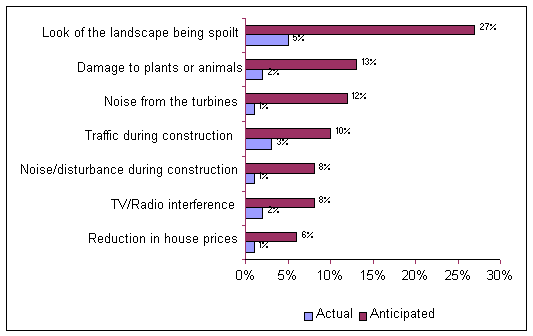
This first
bar chart shows a survey on the environmental effects of a wind farm. The
actual effects are always far less important than they were thought to be.
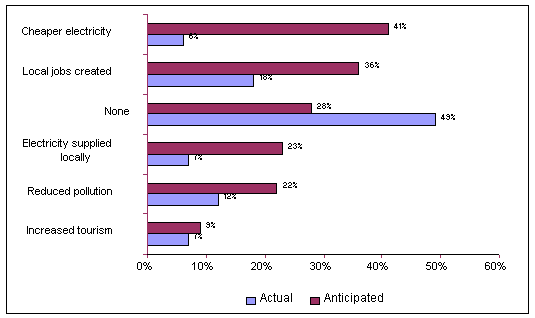
This second graph shows the economic and social
effects of the implementation of a wind farm. As expected electricity is
supplied locally and the pollution is also reduced but on the other hand the
effect on the price of electricity is very small compared to the effect
expected. Only half the jobs expected to be created actually materialized.
General Environmental Statement
The global impacts of a marked increase in renewable energy usage have potentially profound benefits and consequences that will affect both the global environment. The current global warming trend caused by greenhouse gasses truly threatens almost every aspect of natural life that we can imagine. A global effort to reduce the trend must include a diversion from dependence on traditional fossil fuels, such as coal and oil, to a more integrated approach utilizing renewable energy technologies.
Social Issues
a) Employment Creation
i) Biomass
Survey conducted by British Biogen found that 4.2 jobs would be created by biomass fuelled CHP plant per MW installed. This figure was substantiated by the experience of Border Biofuels who are actually employing 4 people for every MW of plant installed in Carlisle.
It was consequently assumed that the Lochgilphead project, with 4.5MW CHP capacity, would employ 18 people.
ii) Hydro, Wind and Total Project Control
These are grouped, as they are unlikely sources of long-term employment. The project estimated that 1 person would be employed to maintain each and 1 other to provide control and oversee the total project
Total Long-term Employment - 21
b) Other Social Issues
No other effects of small-scale deployment were measured during by this project. The benefits accrued to small-scale deployment are covered elsewhere on this website