Details of
Lochgilphead
|
Contents
 Why did We Choose Lochgilphead?
Argyll and Bute Energy Strategy
Why
did we choose Lochgilphead?
The first reason why we chose Lochgilphead, as a
case study is the area has obviously great potential as far as renewable
resources are concerned and is not being exploited at the moment as we found
out form the Argyll and Bute Council’s Energy Strategy.
We also felt the town was a reasonable size of
its population (i.e. not too small, not too big). And finally the demand
information was available.
Introduction
to the Area
Population
Statistics
The Argyll and Bute Council provided the 1991
Census Fact sheet to us. It allowed us to get an idea of the population in
Lochgilphead and the kind of activity within the village.
The age profile of the residents of Lochgilphead is as follow:
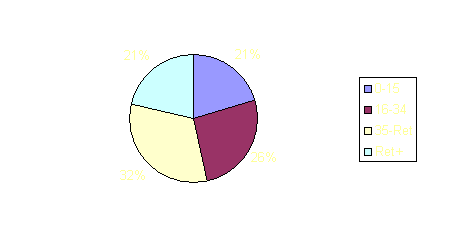
We can notice that about 54% of the population is 35 years old or over.
Almost 90% of the population is Scottish and nearly half own a car.
The economic activity of the residents
of Lochgilphead is as follow:
|
|
Male |
Female |
Total |
Percentage |
|
Employees FT |
468 |
303 |
771 |
65.3 |
|
Employees PT |
21 |
174 |
195 |
16.5 |
|
Self Employed |
86 |
24 |
110 |
9.3 |
|
Govt Scheme |
19 |
7 |
26 |
2.2 |
|
Unemployed |
51 |
28 |
79 |
6.7 |
|
Econ inactive |
275 |
501 |
776 |
- |
|
Total |
920 |
1037 |
1957 |
- |
The economically
active people represent 93.3% of the population in Lochgilphead, which is a
very large majority of the people living in the village.
The housing characteristic in the village is as
follow:
|
Household Characteristics |
|
|
|
|
Total |
Percentage |
|
1 single adult |
92 |
10.3 |
|
> 2 adult, no children |
364 |
40.9 |
|
> 2 adults, + children |
250 |
28.1 |
|
Single Parents |
26 |
2.9 |
|
Lone Pensioner |
157 |
17.7 |
|
> 2 pensioners |
140 |
15.7 |
|
Types of Accommodation |
|
|
|
|
Total |
Percentage |
|
Detached |
215 |
22.7 |
|
Semi-detached |
178 |
18.8 |
|
Terrace |
308 |
32.6 |
|
Flat (purpose building) |
193 |
20.4 |
|
Flat (conversion) |
53 |
5.6 |
|
Not self contained |
0 |
0.0 |
|
Non permanent
accommodation |
2 |
0.2 |
The total number of
households with residents is 904. There are 145 households without central
heating, 2 with no inside WC and 3 without a bathroom. In addition there are 39
vacant accommodations, 6 second homes and 1 holiday accommodation.
Maps
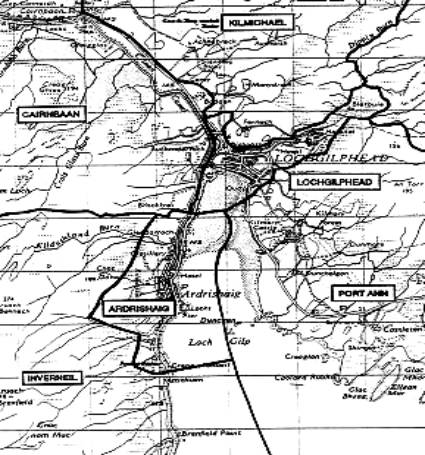
Settlement Map
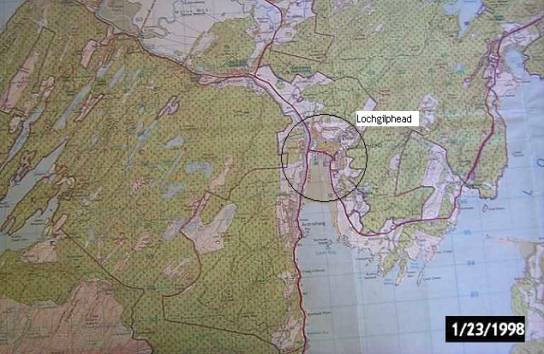
Ordnance Survey Map
Current
Energy Supply
Scottish Hydro-Electric and Southern Electric
provide the electricity in Lochgilphead by means of the Sloy/Awe Hydro Electric
Scheme.
According to the Council, more than 95% of the
houses in the village only use electricity as power and mean of heat using hot
brick storage, as the village is under the Economy 7 plan, which encourages
people to use electricity when it is the cheapest, that is to say early in the
morning between 00h00 and 07h00.
Argyll & Bute Energy Strategy
Argyll and Bute is an area where there is an abundance of energy generated from renewable sources. However the physical and demographic characteristics of the area generate direct or indirect energy related problems such as cost of living, transportation costs, a greater potential for health risks due to cold and dampness, a lack of energy efficiency information for householders and businesses.
Already,
Argyll and Bute has recorded substantial potential savings in residential,
industrial, and Council buildings. But most of all it has been identified that
local renewable energy generation for local consumption could produce cheap and
sustainable energy giving business an economic advantage and everyone else
within Argyll and Bute affordable energy.
The challenge is to get people
to think about energy issues and by advising and assisting in order to enable
them to become more energy efficient or to capitalise on their local renewable
energy resources.
The Council’s Approach:
The Council’s approach
towards energy issues has been focused by its will to improve the quality of
life and opportunities for the people of Argyll and Bute.
Aim:
To promote affordable,
sustainable energy generation and management within Argyll and Bute.
Objectives:
Energy Management:
To ensure the people of
Argyll and Bute have the necessary information, advice and assistance to enable
them to take necessary actions to reduce energy consumption and to promote
energy efficiency.
Renewable Energy
Promotion:
To promote the local
generation and consumption of renewable energy within Argyll and Bute.
Energy Costs:
To ensure access to the
people of Argyll and Bute to competitive priced energy sources.
In order to do so the Council has launched a series of energy awareness programs for households, schools and businesses but also renewable energy programs to study the effects of local generation and consumption of renewable energy and finally affordable energy program in order to move towards similar costs to anywhere else in the UK.