Transportation
 Current concerns regarding pollution and the depletion of our natural resources caused by the internal combustion engines of the world's ever-expanding fleet of automobiles has led federal and state governments to implement regulations requiring greater fuel efficiency for new models.
Proton exchange membrane fuel cells can help automobile manufacturers to meet these goals because they operate at 35 - 40 percent fuel efficiency compared to 10 - 20 percent efficiency of internal combustion engines.
As the figure below demonstrates a realistic efficiency curves for a High Speed Dierct Injection Diesel (HSDI), the most efficient car engine avaliable, a direct injection gasoline engine, the latest and most efficient gasoline engine and the theoretical curve for a fuel cell fuelled by hydrogen.
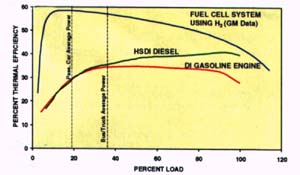
Examination of the shape of the curves, though, reveals that the fuel cell reaches its maximum efficiency at about 20% load and this is the average load for a passenger car engine.
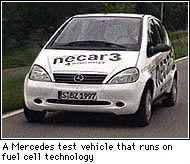
In September 1997, Daimler -Chrysler revealed its fuel cell powered NECar3 in Germany; and in March 1999, Daimler-Chrysler announced NECar 4, the first zero-emission fuel cell car in the US. Furthermore, the fuel cell system is small enough and installed in such a way that up to five people can ride in this compact car. Daimler-Chrysler plans to be producing between 40,000 and 100,000 fuel cell powered cars per year by 2004 or 2005.
Other automobile manufacturers are performing substantial amounts of research although they are all at varying stages of progress. Again, affordability is one of the major challenges on which research is focusing. The fuel cell system in the NECar 4 costs $30,000, or approximately 10 times that of a conventional internal combustion engine.
One important issue surrounding the use of fuel cells in vehicles is the need for safe, portable storage of hydrogen. Storing pure hydrogen in the vehicle could be dangerous and cause an explosion so alternative sources of hydrogen must be explored. However, that means additional equipment must be located in the vehicle to separate out the hydrogen, adding to both size and cost. Widespread availability of hydrogen refuelling facilities will also need to be addressed. Current research efforts are exploring metal hydride storage possibilities and methanol- and gasoline- reforming methods, as well as hybrid vehicles that run using a combination of fuel cells and batteries.
While this kind of technology is very expensive to be applied on transportation, in the long run it could be cheaper to operate due to fuel savings.