


The user needs to become familiar with and understand some of the terms used in Norma. The following explains the principles:
 During hot weather inside temperatures within a building rises due to a combination of the
following:
During hot weather inside temperatures within a building rises due to a combination of the
following:
Heat gain from external or internal sources can be lessened by the following:
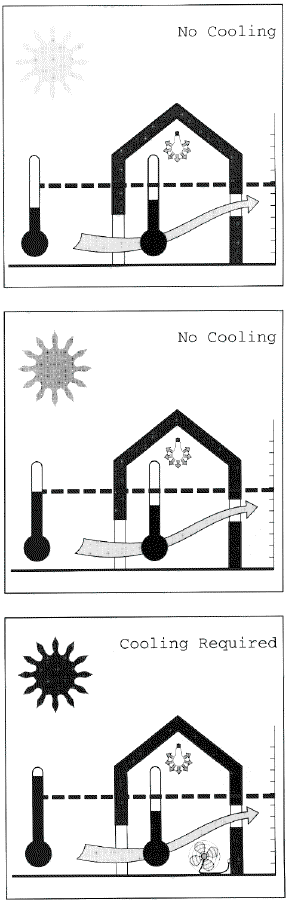
The building may be cooled by ventilation, evaporation or ground-coupled cooling using a variety of techniques. The figure(s) of the simple building to the right illustrate the concept of Set Point and Balance Point Temperature.
The comfort of building occupants depends on temperature, on air movement and on the activities of the occupants. For example, air movement cools people through evaporation and convection, and so increases the temperature at which people feel comfortable. Having taken into account activity, air movement, ventilation, etc., it is possible for a designer to decide what is highest temperature for occupants to remain comfortable. That temperatureis called the Set Point Temperature. It is important to stress that this is avalue chosen by the designer, that it is not an absolute value and that it will vary from building to building depending on cooling strategy. Usually the Set Point Temperature in a naturally cooled building can be 2-3 degrees C above that of an air-conditioned building and achieve the same level of comfort.
When the form of a building has been decided and cooling strategy chosen, it is possible to predict the amount of internal gains from equipment and occupants, the direct and indirect gains from solar radiation and the amount of natural cooling achieved. With all these factors taken into account, it is possible to estimate to what extent increases in the external ambient air temperature would bring about increases in the internal temperature of a building, and in consequence what value the external ambient temperature would have to reach to cause the inside temperature to reach Set Point Temperature - the maximum internal temperature for comfort. This critical value, the point at which the external ambient temperature would cause discomfort, is called the Balance Point Temperature. This will vary from building to building depending upon the strategies that have been developed to protect the building from external and internal gain and for natural cooling.
For any given building, the Balance Point Temperature will vary from hour to hour, as the amount of gain from solar radiation, occupancy and use of equipment varies.
When external ambient temperature exceeds the Balance Point Temperature, the building will need to be controlled mechanically to maintain comfort. The amount of energy needed to cool the building mechanically to comfort level is called the Cooling Load. A building with a high Balance Point Temperature will have a low Cooling Load since the number of hours that the external ambient temperature exceeds Balance Point Temperature will be fewer and since the building will have to be cooled through a smaller temperature range.