In this lecture the interaction of the climate with the building system is discussed. The main climate variables are identified and methods for their application in modelling and simulation are described.
You can access more information under a variety of topics:
Extract from text book:
"Energy Simulation in Building Design"
J A Clarke, 1985
In most energy modelling exercises the modus operandi is to test alternative design possibilities against short period climatic data considered representative of typical or extreme (hot, cold and moderate) weather influences. By such comparative means the favoured design elements are selected and the final (or near final) scheme subjected to long term simulation, usually annual, to determine energy consumption trends. In some cases atypical weather patterns will be required to test component response under extreme loading. The selection of climatic time-series collections, to provide meaningful simulation boundary conditions, will require great care. Of fundamental importance is the typicality of the collection in relation to the elements of the design problem in hand. Generally two conditions require to be met:
The former requirement is concerned with the availability of relevant, and site specific, climatic data and the latter requirement with the rank ordering of this available data according to severity criteria which include building specific factors.
Section 5.8.1 deals with the availability of climatic data, in computer readible form, suitable for energy simulation applications. Section 5.8.2 outlines the the various 'Test Reference Year' selection procedures and proposes an index of climatic severity. And finally section 5.8.3 briefly considers solar radiation prediction often necessary in the absence of measured data.
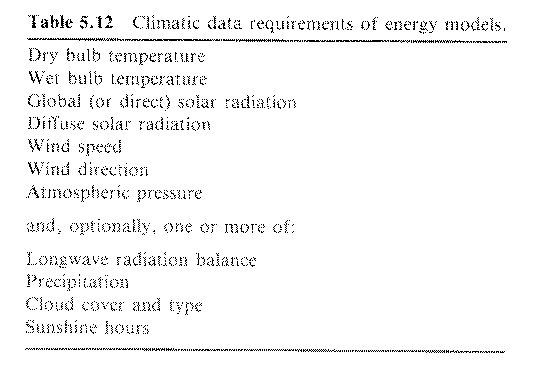
Table 5.8.1 summarises the main climatic variables required for energy simulation modelling. Many weather observation centres exist worldwide to collect these (and other) data at frequencies of one hour and greater. Until quite recently few of these centres recorded direct and diffuse (or global and diffuse) solar radiation intensities - as required by energy modelling systems - although cloud data (amount and type) is often available to permit intensity assessment by prediction.
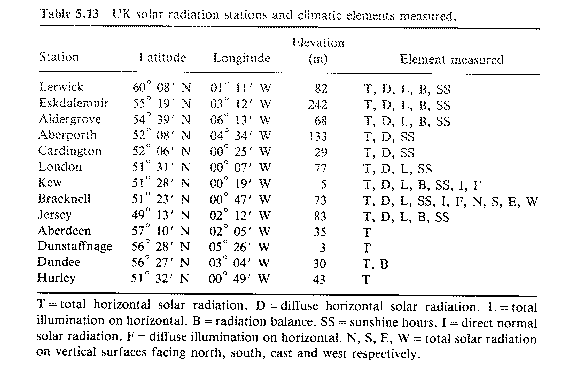
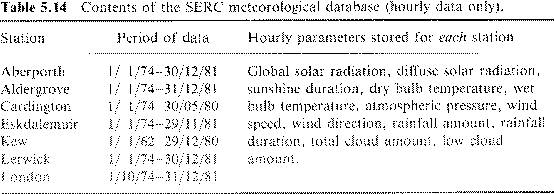
In Britain the Meteorological Office has archived data relating to various country-wide stations as well as a small number of stations overseas. Table 5.8.2 gives the various solar radiation stations in the UK and indicates the climatic parameters recorded at each. As part of the Science and Engineering Research Council's Specially Promoted Programme - 'Energy in Buildings' - a UK climatological database has been established initially for non-commercial use [Page et al 1983]. Table 5.8.3 gives the contents of this database.
In the US extensive climatic data is available - for example 'Test Reference Year' (TRY) collections (see section 5.8.2) have been compiled for more than 60 cities - although solar values are often missing and replaced by cloud cover observations.
The need to accurately simulate building energy exchanges has lead to the necessity to establish techniques by which climatic data, of a given severity, can be extracted from the years of historical data available for any given location.
In 1974 the NATO committee on 'Challenges of Modern Society' initiated, as part of a project on the rational use of energy, a sub-project dealing with 'Climatic Conditions and Reference Years'. The objective of this project was to recommend methods for producing a 'Test Reference Year' (TRY) for any locality for which extensive climatic data was available. A TRY is a weather collection consisting of 8760 hourly sets of mandatory and optional climatic data which, against some criteria, can be declared representative. At present a number of countries have TRY data ready for commercial or research use although the procedures used to establish a TRY will vary by country.
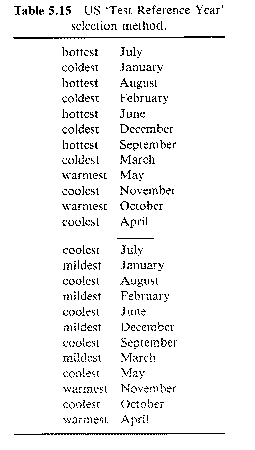
In the USA [TRYUSA 1976] the procedure is to eliminate those years, in a period of record, containing months with extremely high or low mean temperatures until only one year - the TRY - remains. This is achieved by marking those months within the period which can be described, in terms of mean monthly temperature, as shown in table 5.8.4. The procedure then continues by marking those months which can be described as the next-to-hottest July, the next-to-coldest January and so on until one year remains without any marked months. The method is extremely simple to apply and the resulting TRY is considered useful for comparative studies but not for the estimation of long term energy consumption.
In Japan an alternative selection procedure is used [Saito et al 1974] based, not on the climatic variables, but on the cooling and heating loads to result from the application of the climate to a standardised design problem. These loads are computed hour-by-hour over a ten year period, for two different enclosures and four different orientations. This gives eight different ten year profiles. The procedure is then repeated for each individual year in the period of record and the yearly profile considered 'nearest' to the ten year profile (over all eight cases) is declared the TRY.
The Danish selection procedure [Lund 1976, Anderson 1974] is based on a rigorous statistical analysis applied to eleven years of climatic data. TRY selection is based on the daily mean dry bulb temperature, the daily maximum dry bulb temperature and the daily total of solar radiation according to three criteria:
Each month is rank ordered according to these criteria and the TRY selected.
A South African procedure involves the selection of typical hot days on the basis of either the daily maximum sol-air temperature or daily maximum dry bulb temperature occurring on 10, 5 and 2.5 per cent of the days in the period considered. Typical cold days are selected on the basis of daily minimum temperatures. A study initiated by the UK Building Research Establishment and the Meteorological Office proposed a similar method [IHVE 1973].
In the UK the Chartered Institute of Building Services have produced an 'Example Year' based on a selection method proposed by Holmes et al [1978]. Based on global and diffuse solar radiation, wind speed, dry bulb temperature and degree days, the method eliminates any year containing a monthly mean which varies by more than two standard deviations from the long term mean for this month. The recommended 'Example Year' is October 1964-September 1965 from the KEW observatory or, if a calander year is required, the 1967 KEW collection. These data are considered adequate for predicting energy demands but not for peak load estimation.
Excluding the Japanese procedure, each of these methods suffer from two main defects:
In one recently completed research project [Markus et al 1984] a technique was developed which allows the assessment of an index which defines the stress any given climate would place on a house design of known characteristics. This Climatic Severity Index (CSI), which is house type specific, indicates, by a single number on a dimensionless scale, the stress placed on the building's energy system by any given climatic collection. Of course a CSI already exists - the simple degree day total - but this is inadequate because it excludes the effects of important climatic parameters and only includes building characteristics in the most rudimentary manner (via the base temperature).