Simulation for environmental engineering - Methodology
Key concepts:
- performance assessment methodologies;
- how to use modelling and simulation in system design and performance
evaluation; relative vs absolute;
- rank ordering of options;
- selection of indoor/outdoor boundary representation;
- conversion of problem - input data - results - information;
- selecting appropriate modelling and simulation level.
Lecture structure:
- What is the question ? ("problem led")
- relative vs. absolute
- rank ordering
- selecting appropriate level
You can access more information under a variety of topics:
Course material (initial):
1.0 Simulation methodology
The most critical aspect of modelling is the planning and organisation
of work to address the needs and goals of a project within its resource
and time constraints (Hand and Strachan, CIBSE GUIDE, 1996). The procedure
involves the following steps:
- define design questions;
- translate to modelling objectives;
- plan and prepare model;
- simulate; and
- interpret results
A brief synopis of these aspects are:
1.1 Defining the Design Questions
Asking the right questions at the appropriate stage of the design process
is fundamental in achieving the maximum benefit from undertaking a building
performance assessment. For Example:
- Early design stage: are orientation of building and glazing ratio reasonable
?
- Mid-design stage: is there a requirement for air-conditioning ?
- Late design stage: what control strategy will provide energy efficiency
?
The use of an integrated design approach will help maximise the the
return from a modelling exercise, where all members of the design team
work closely together to realise the aims and design targets for the building.
An integrated approach will enable energy efficient features to be incorporated
at all stages at little or no extra cost.
Key issues may be identified by carrying out design checks using simple
tools to evaluate orientation options and form issues such as site layout.
This will add confidence to the overall approach and highlight the critical
issues and unanswered questions.
1.2 Translating Design Questions to Modelling Objectives
Can the design question be expressed as a modelling task ? This will
be dependent upon the choice and applicability of the assessment tool used
in simulation to address the design question, e.g.
Design Question: Does the building require air-conditioning
?
Modelling Task: Define overheating with respect to peak
summertime temperatures and frequency of occurance within a naturally ventilated
scheme.
1.3 Model planning and preparation
Once objectives are decided upon, develop a clear procedure for modelling.
This enables:
- quality assurance
- design team member checks on modelling
- consistency of approach to similar problems
The procedure should:
- identify appropriate design tools/programs and
- the required level of modelling resolution(abstraction)
The result is:
- specification of necessary data to develop appropriate model and
- sequence of assessments necessary to evaluate performance
Figure 1 set outs a typical procedure: in a phased study or when different
aspects of the design are assessed with multiple design tools.
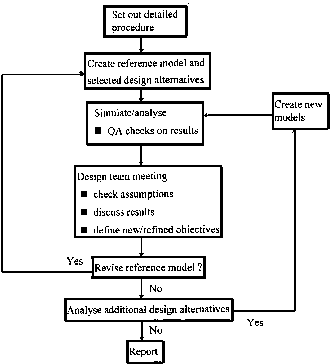
Figure 1. Typical Modelling Methodology
Model Abstraction
The representation of the level of physical reality within the model
is a key concept. (see
Level of Abstraction)
In terms of the level of detail, the aim is to keep the model as simple
as possible and avoid significant errors that will result from over simplification.
One means to achieve the correct level of detail required for the various
building sub-systems, i.e. constructions, lighting, etc. is to use previous
case studies or personal experience. In the absence of these the best peocedure
is to create a preliminary reference model with:
- simplified geometry
- known or estimated constructions
- known or estimated internal gains(and their variations with time)
- design compliant ventilation rates
- ideal plant and control
Regarding Modelling Accuracy
- design tools need sufficient accuracy for practical purposes
- the level of detail will affect accuracy
Reference Model
Parametric investigation requires a reference or base case model for
comparison.
- for new build projects, the reference model is normally the initial
design content
- for refurbishment projects, the reference model is normally the existing
building
Other modelling issues
- climate
- zoning
- shading and internal solar distribution
- ventilation and infiltration
- plant and control
- occupancy and small power
- thermal bridges
- computational parmeters
- risks and uncertainty
1.4 Results interpretation
The results of the simulation need to translate the reporting features
of assessment tools to clear, concise, quantitative information enabling
decision making.
Presentation of results should convey the appropriate level of information.
Some general points are
- Brief the client based on interative process.
- Keep presentation relevant without focus on detailed interpretation.
- For parametric assessment, clearly define variation to the reference
case.
- Quantify where possible.
- Explain results.
Elements of presentation
- Objective statement
- Summary of main findings (Executive summary)
- Brief details of design tool capabilities
- Model description
- Model assumptions and sensitivity analyses
- Note of design variations from reference case
- Graphical and tabular results
- Conclusions set against stated objectives
Further reading:
- Use of sophisticated building
energy simulation tools
