
You can access more information under a variety of topics:
The absence of adequate electrical power modelling within building simulators in general is an important omission when we consider that (in 1991) electricity accounted for 15% of energy consumption by end users, some 241,048 GWh, of this total some 155,655 GWh was consumed in the built environment, (58%). This accounts for some 8.7% of total energy end usage (DTI, 1992). In financial terms, electricity sales to the residential, commercial and public sectors were 11,415m.
Figure1 Summary of energy utilisation
The built environment already accounts for some 19% of carbon dioxide emissions, however, if we add on the figure for emissions due to production of electricity for the built environment, this figure rises to around 39% of total CO2 emissions (61 million tonnes).
Analysing the figures it is apparent that consumption of electrical energy in the built environment is highly significant in both an environmental and economic context.
To date the majority of attention in the building simulation community has been focused on examining the energy end-use of the building system. Energy efficiency is, of course, always desirable especially where the energy supply is purchased from an external utility supplier.
The main electrical loads in building systems can be summarised as:
Lighting
General office/domestic appliances
Auxiliary systems
Losses
Three phase supply
Large electricity consumers have three phase supplies. The building design (electrical) engineer will endeavour to arrange loads such that the consumption from each phase is about equal.
Power factor
Electricity utility companies generally operate a tariff structure which encourages the consumer to avoid operation at low power factor. Most appliances which have a characteristically poor power factor (<0.8), and which constitute the standing load of the building (e.g. fluorescent lights), will incorporate components to correct the p.f. to an acceptable level (0.8<p.f.<1.0).
A substantial portion of the heat injection in the model of a building's energy system will often be due to the radiant and convective components of the so-called `free' gains from lights, occupants and heat generating equipment. If we consider the example of a photocopier, this component will create both a thermal and an electrical load on the building.
Of the normal heat sources found in buildings, perhaps lighting systems offer the most potential for energy savings. Critical sizing of fittings, and switching on the basis of lighting levels, can result in significant electrical energy reduction and, in the case of air-conditioned buildings, reduced cooling loads.
With the advent of combined heat and power, and latterly photovoltaic facades, electrical energy production has become very much a part of the overall building system and hence the potential benefit which may be obtained by incorporating energy sources into the building model has become increasingly apparent. See `Power flow modelling: Generation' below.
The theory behind computer modelling in electrical power systems analysis has been well established for well over twenty years (Stagg and El-Abiad, 1965), while digital computers have been used in power systems simulation since the 1940's.
In power flow simulation the power system is modelled as a series of inter-connected nodes, or busbars with individual loads and generation sources connected to a particular busbar (or `bus'). In general, normal methods of circuit analysis are not used as in most cases load impedances are not known. Loads are known as complex powers while generation is modelled as a complex power source, rather than a voltage or current source which is the case in normal circuit analysis.
At each busbar, power is either generated, absorbed by a load, or transmitted. The summation of these power flows is always zero. The purpose of the power flow solution code is to determine the power flow between nodes (of both real and reactive power) plus the voltages and phase angle at each bus.
Load
In power flow simulation a required condition for solution is that all loads are known, hence loads can be regarded as boundary conditions for the problem. Load calculation is the primary interface between the building simulation tool and load flow solution code with the simulation tool supplying the power flow analysis tool with dynamic load information at each simulation timestep.
Generation
The type of generation found in modern energy efficient buildings is generally of a combined heat and power type. Examples of this are a gas engine unit with heat recovery powering a synchronous generator or a PV facade with heat recovery. These two distinct systems serve almost exactly the same purpose in both supplying power and thermal energy to the building.
Power flow
The transfer of electrical energy within the building system is usually thought of in terms of the power flow along the inter-connecting `lines' (i.e. cables). The main task of the load flow solution tool is to calculate the power flow between nodes. To achieve this a knowledge of the inter-connections between nodes (i.e. lines and transformers) is required as well as a knowledge of the impedance of all components.
Normally, in power system solution, admittance values are used (admittance is the inverse of complex impedance) and these are formed into a system matrix which, in essence, contains all the information regarding inter-connecting components in the system.
In any type of power systems analysis three types of busbar can be encountered:
The reference bus is generally connected to a generator. After calculating system power flows the residual of the sum of the loads - minus total generation, is injected at the swing bus, this value is equivalent to system losses which can only be determined after network solution.
Load buses comprise over 80% of most systems, in the load bus real and reactive power flows are known but voltage and phase angle must be calculated.
The generator bus is, as expected, a bus to which a generator or multiple generators are linked. Voltage and real power flow are regarded as known quantities, while reactive power and phase angle are unknown.
Buses are linked by one of two components; the line or the transformer. The line, or cable, impedance is represented in the simulation by series and shunt (parallel) components.
Like the line the transformer also transfers power from one point in the system to the other while, if required, converting the voltage from one level to another. The purpose of the `regulating transformer' is to control the voltage of one of the buses it connects within defined limits. This is done by changing the winding ratio (and hence also the impedance characteristics) of the transformer in response to varying system voltage.
Power balance
The important variables at each bus are PGi, QGi, PTi, QTi,PLi, QLi and Vi, representing the generated power, transmitted power, load (power) flows and voltage at the busbar. The summation of the power flows is always zero. Solution is usually by means of an iterative method either Gauss-Siedel or Newton-Raphson, the two variables solved for each node are voltage and phase angle, from which, given the system admittance matrix, all other system properties can be determined.

Figure2 Total system modelling.
Solution of the total system requires a simultaneous solution of both the building plant system and the electrical subsystem. The solution of the building plant system provides the boundary data for the electrical simulation.
Information provided by the building side simulation is as follows:
Information provided by the power flow simulation is as follows:
The information from the load flow simulation is a snapshot of the system conditions at a particular instant and takes no account of short-term transient phenomena.
The information derived from the system simulation can be used (in conjuction with a control strategy) to modulate system operation i.e. switching on and off loads in the building to reduce peak loadings, or switching on or off generation units to cope with changing demand.
Finally we will look at an actual simple system simulation carried out using the ESP-r power flow and building solver in parallel. The actual system modelled consisted of a 17-zone building with an array of PV panels on the roof. The PV was augmented with a grid connection. It is assumed that the PV power output is inverted and used to supply some of the building load. For information on the modelling of the PV material refer to "Modelling Active Building Elements with Special Materials" (Evans & Kelly, 1995).
Data for the PV panels is taken from the manufacturers data sheet, in this simulation the panels used are BP `Saturn' panels with a peak output power of 354W per panel (pulse test). The panel array is situated in the south facade and roof area of the building.

Figure3 Simulation Model.
The simulation is run as an example of the modelling potential of combined thermal/electrical simulation and hence the detail of the results output is not discussed here.
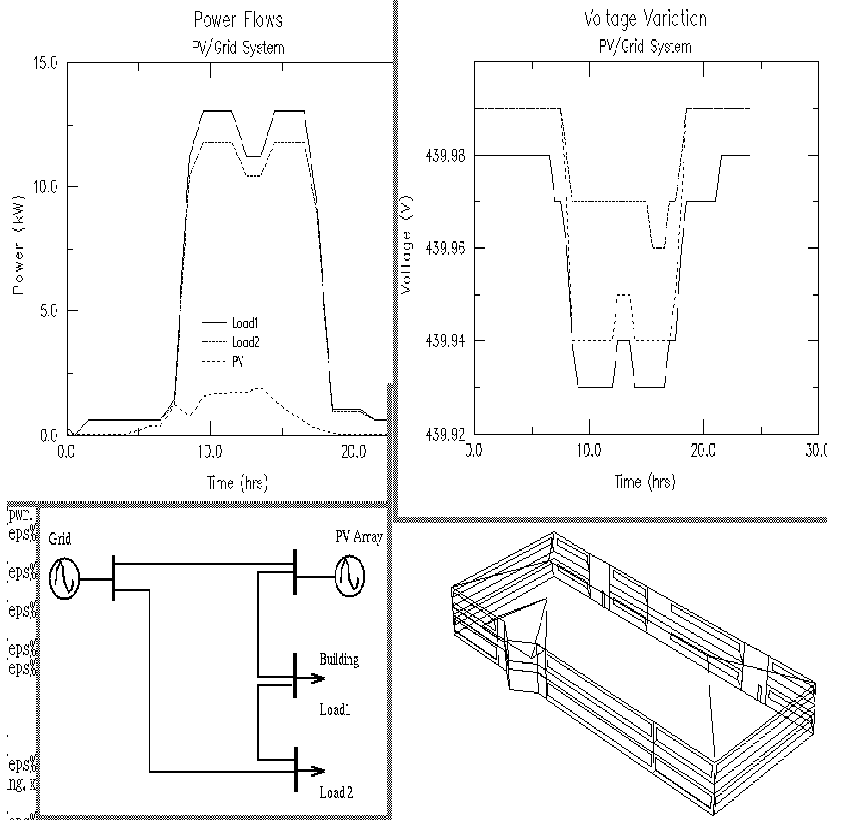
Figure 4 Sample Simulation Output
Buresch M. Photovoltaic Energy Systems - Design and Installation , McGraw-Hill, New York, 1983.
Gross C.A., Power Systems Analysis , John Wiley and Sons, New York, 1979.
Clarke J.A, Energy Simulation in Buiding Design , Adam Hilliger, Bristol, 1985.
Stagg G.W, El-Abiad A.H., Computer Methods in Power Systems Analysis McGraw-Hill, New-York, 1968.
Dept of Trade and Industry, Digest of United Kingdom Energy Statistics, HMSO 1992.